Kaiser FC/ Matchday/ Archive 009
Archive 009
Aftermath & Memory
9 min read

The Long
Way Out

Every supporter leaves the ground carrying a different version of the match. Some carry relief. Some carry anger. Some carry silence. The final whistle ends the game, but it does not end what the game has done to the people who watched it.

The final whistle is never the end of matchday.

It is only the moment the game stops moving on the pitch and starts moving through the people who watched it.

For ninety minutes, everything had a direction. Eyes toward the grass. Bodies leaning forward. Voices rising and collapsing with the ball. Hope attached to every pass, every clearance, every run into space, every corner won, every second added by the referee. Then the whistle goes, and the shape of the afternoon breaks.

The players shake hands, argue, collapse, wave, disappear. The scoreboard becomes fact. The pitch, which had held thousands of people in emotional captivity, suddenly looks too large and strangely empty. The match is finished. The result is no longer negotiable. Nothing shouted from the stand can change it now.

And then comes the long way out.

Every ground has one. It may be a concrete stairwell, a narrow tunnel, a sloping road behind the stand, a bridge over train tracks, a line of police horses, a muddy path beside a brick wall, a street of shuttered shops, or the slow descent from a terrace where nobody moves quickly because nobody is ready to return to ordinary time.

The long way out is not a route. It is a condition.

After a victory, it begins with bodies that do not want to separate. Supporters linger at the top of steps, still singing, still turning back toward the pitch, still repeating the decisive moment to anyone close enough to listen. People who were strangers ninety minutes earlier now speak with the intimacy of men who survived something together. Someone laughs too loudly. Someone keeps saying the scorer’s name as if repetition might keep the goal alive. A father lifts his child higher than necessary. Old men walk more slowly because they have seen enough football to know that days like this should not be abandoned too quickly.

The exit after a win is full of delays. Nobody says, “I want this to last longer,” but the body says it. The walk pauses at railings, under stairways, beside gates, outside pubs, near programme stalls, in patches of light where supporters wait for friends they are not really in a hurry to find. The match follows them in fragments. The goal. The save. The tackle. The song after the second goal. The moment everyone thought it was gone. The moment it came back. The same details are retold in different voices until the result becomes communal property.

A good win makes the road outside the ground feel wider. The city seems temporarily more forgiving. Traffic sounds less hostile. Strangers in the same colours nod without speaking. Scarves stay around necks longer. The air has been changed by the score.

But the long way out has another face.

After defeat, the same stairs become heavier. People move differently. There is less looking back. The conversations are shorter, sharper, or absent entirely. A man who shouted all afternoon says nothing. A child asks one question too many and receives an answer too small. Programmes are folded without care. A scarf is taken off before the street. Someone blames the referee. Someone blames the manager. Someone blames the entire decade.

Defeat does not leave the ground in one mood. It leaves in layers.

There is anger near the exits, where disappointment still has heat. There is analysis on the pavement, where groups stand in circles and perform the autopsy before the players have even showered. There is silence at bus stops. There is dark humour in pub doorways. There is denial in the man who says it does not matter when everyone can see that it does. There is the strange calm of older supporters who have known worse and do not need to announce it.

The long way out after defeat is where football tests the durability of belonging.
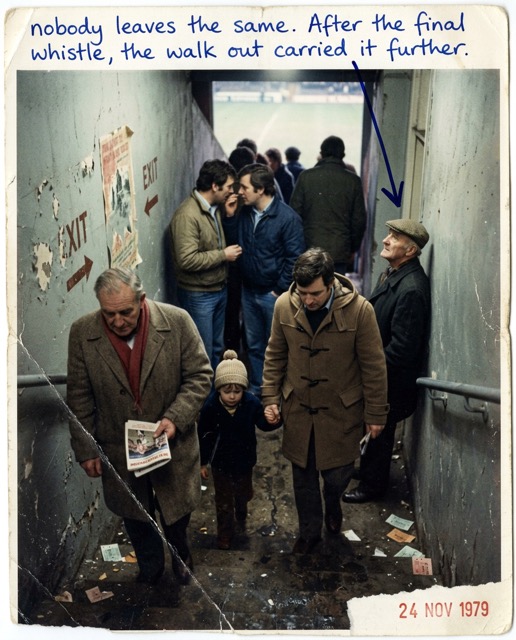
The Heavy Descent

Support is not only expressed in arrival.
Sometimes it is expressed in the decision
to leave angry — and still come back.

The afternoon has taken your money, your voice, your hope, and returned nothing but a result you will carry home unwillingly. This is why the exit matters.

Supporters descending a concrete stairwell after the final whistle

It is easy to belong when the crowd is singing and the team has given you proof. It is harder when the proof goes the other way. When the afternoon has taken your money, your voice, your hope and returned nothing but a result you will carry home unwillingly. This is why the exit matters. Support is not only expressed in arrival. Sometimes it is expressed in the decision to leave angry and still come back.

There are also draws, which produce their own uncertain weather. Nobody knows how to walk after a draw at first. The body searches for the correct posture. Was it a point gained or two lost? Did the late equalizer save the day or expose the problem? Should people applaud or complain? The conversations outside the ground become courtroom proceedings. Evidence is presented. Interpretations are challenged. The same match divides itself into several possible truths.

That is one of football’s quiet cruelties: it does not always tell you how to feel.

The long way out is where that uncertainty has to be carried in public.

Three Ways Out The Same Road — Three Different Weathers
Win
Bodies that don’t want to separate. The walk pauses at every railing. The result becomes communal property.
Draw
Nobody knows how to walk at first. A point gained, or two lost? One match, several possible truths.
Defeat
The same stairs become heavier. It does not leave in one mood. It leaves in layers. Leave angry — and still come back.
The final whistle does not tell you how to feel

Older grounds made this process visible. Their exits were rarely smooth enough to hide emotion. Supporters were compressed into stairwells, filtered through gates, slowed by barriers and narrow streets. Movement forced proximity. You could not leave a match completely alone even if you wanted to. You heard other verdicts. You saw other faces. You absorbed the collective mood whether you agreed with it or not. The route out acted like a final concourse of feeling.

In those old exits, the game continued in fragments. The chant that refused to die. The argument that started on the terrace and moved into the street. The man selling newspapers. The police line watching from the corner. The smell of onions, diesel, rain, beer, tobacco and damp wool. The sound of boots on concrete. The first bus pulling away full of supporters replaying the match before the radio could.

The stadium released people slowly, and maybe that was right.

Clean endings belong to schedules.
Not to football.

Football stays under the skin. It follows people through gates and down roads and into cars and onto trains. It sits beside them at dinner. It waits inside the Monday conversation. It alters the way a man opens the newspaper, the way a child describes the day at school, the way a friend sends a message that begins with nothing but the score.

The final whistle is official. The ending is personal.

That is why some of the most honest football photographs are taken outside the ground after the match. Not during the goal. Not during the anthem. Not when the players walk out. After. When the performance has ended and the faces have lost the protection of anticipation. You can see everything then. Relief in bodies that have stopped pretending to be calm. Defeat in shoulders. Joy in people who do not know where to put their hands. Silence in men walking side by side, each carrying the same result differently.

Inside the ground, supporters belong to the crowd. Outside, they become themselves again, but not immediately. The long way out is the corridor between those states. It is where the crowd breaks back into lives.

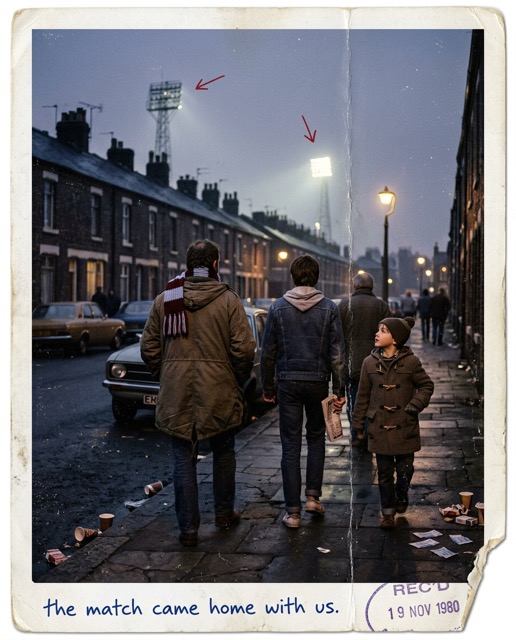
A father and son leave together.

A father and child walking away as the stadium fades behind them

Part Of The Inheritance

Years later, the son may forget the score
and remember instead the road, the cold,
the hand on his shoulder
the crowd behind them fading with every step.

Either way, the walk becomes part of the inheritance. The stadium stays in sight until the road bends.

If the team won, the father may talk too much, trying to place the day inside a history the child does not yet understand. If the team lost, he may try to protect the child from the full weight of disappointment while failing to hide his own. Either way, the walk becomes part of the inheritance. Years later, the son may forget the exact score and remember instead the road, the cold, the hand on his shoulder, the sound of the crowd behind them fading with every step.

A group of friends leaves through a side gate, already planning the pub, the train, the next match, the same complaints, the same jokes. One of them will claim he knew the goal was coming. Another will call him a liar. Someone will say they are done with this team. Everyone knows he is not.

An old supporter leaves alone. He has done this walk in every mood football can offer. He knows the shortcuts. He knows which exit empties fastest. He knows where the pavement dips, where the police used to stand, where the programme seller once had his spot, where a pub changed its name but not its smell. For him, the long way out is layered with exits from matches that no one around him remembers. He is not only leaving today’s game. He is walking through all the others.

That is the hidden architecture of matchday. The route out of the ground becomes a memory path. Each season adds another layer. The same street holds victory songs, arguments, rain-soaked silences, cup upsets, relegation dread, promotion disbelief, derby rage, ordinary boredom and the rare afternoons when everything seems briefly justified. The pavement does not know this. The supporter does.

Modern stadiums are built to move people efficiently. That is sensible. It is safer. It is cleaner. It is easier to manage. But efficiency has a way of erasing the emotional drag of a place. The old long way out forced the match to remain with you for a while. You could not instantly escape into a screen, a car park, a hospitality exit, a controlled transport channel. You had to walk with it. You had to hear others carrying it too.

There is value in that.

Not because inconvenience is sacred, but because football needs time to settle. A result entering the body is not the same as a result appearing on a screen. The walk out gives feeling a place to move. It allows the supporter to pass slowly from collective intensity back into ordinary life. Without that passage, matchday becomes too abrupt, too consumable, too easily closed like an app.

The long way out reminds us that football was never only an event. It was an interruption in a person’s life that required re-entry.

And re-entry is not simple.

After some matches, the world outside the ground feels offensive in its normality. Cars continue. Shops close. People with no interest in the score walk past as if nothing has happened. The city has not been transformed, even though those leaving the stadium have been. This is one of the loneliest facts of support.

The match can feel enormous to you
and invisible to everyone else.

So supporters carry it together a little longer. They walk slower. They sing into the streets. They argue under railway arches. They gather outside pubs. They wait at crossings. They turn back once more toward the floodlights. They let the ground remain in sight until the road bends or the station swallows them.

Then, finally, the stadium is behind them.

But the match is not.

It travels home in pockets, throats, silences, stories, ticket stubs, empty cups, sore legs, hoarse voices and messages sent before sleep. It becomes what matchday always becomes when the gates close: memory under construction.

The final whistle ended the game.

The long way out decided what people would carry from it.

Share This Archive
Reddit X WhatsApp
Previous in the Archive
Halftime Is
Not A Break
Archive 008  ·  Interval & Belief  ·  9 min read