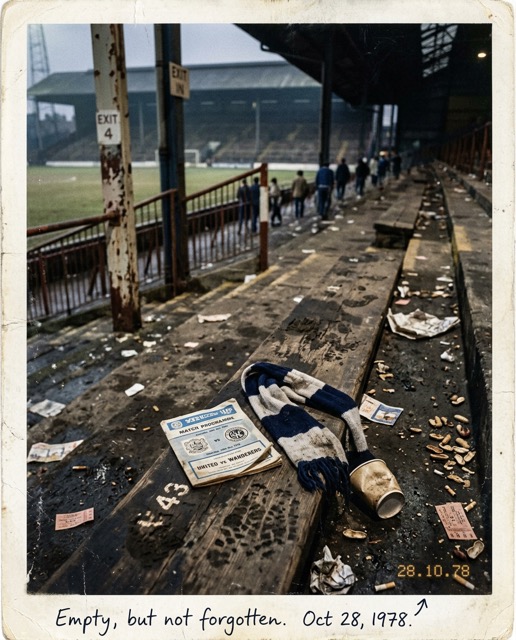
A seat can be empty in many ways.
There is the empty seat of someone late from the pub. The empty seat of someone ill for a week. The empty seat of someone priced out, moved away, banned by work, lost interest, lost health, lost time. And then there is the empty seat nobody discusses much because everyone understands. The place that remains physically available but emotionally occupied. A scarf may cover it for a moment. A hand may touch the back of it before kickoff. The match continues, because football always does, but the geometry has changed.
This is why the phrase “my seat” is often too small for what supporters mean. It is not only a view. It is a history of views. It is the place from which they first saw floodlights against winter sky, first saw a goalkeeper make an impossible save, first learned that anger could travel through a stand like electricity, first understood that grown men could sing without irony, first watched a team collapse, first watched a team rise, first felt the body next to theirs disappear from the routine.
The seat you don’t sit in is not defined by posture. It is defined by return.
Even in seated grounds, supporters often stand at decisive moments because the body refuses to let importance remain seated. A chance builds and the row rises before thought has time to negotiate. A corner is won, and people who have sat through forty minutes of cautious football are suddenly upright, leaning forward, hands gripping the seat in front. A late attack begins, and the whole stand forgets that chairs exist.
The seat may belong to the stadium.
Standing belongs to the nervous system.
That is why the old personal place survives inside new architecture. It may now have a number. It may be printed on a ticket. It may be selected online weeks in advance. But supporters continue to treat certain places as if they carry something more than allocation. They know the walk to them. They know the people nearby. They know how the light falls in August, how the cold arrives in November, how the pitch looks after rain, how the stand sounds when full, and how strange it feels when it is half-empty for a cup tie nobody claims to care about until the match begins.
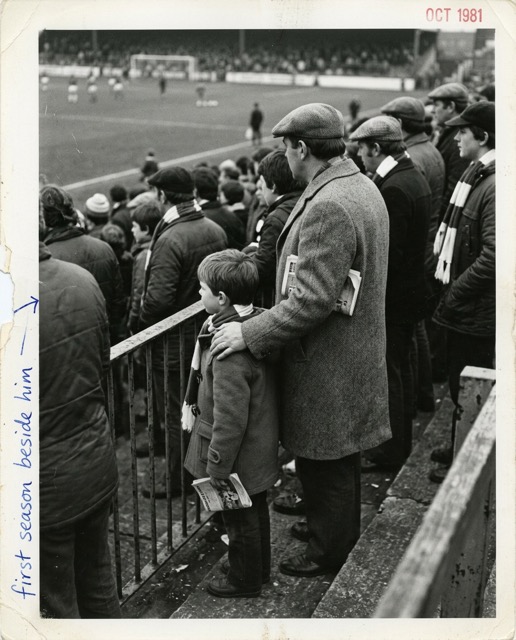
The place teaches loyalty in a way slogans cannot. A club can tell supporters they are family. A marketing campaign can print belonging on walls and shirts and season-ticket brochures. But belonging is built less dramatically. It is built by returning to the same place enough times that the matchday begins to recognize your body. It is built when someone nods because they have seen you there before. It is built when your absence is noticed. It is built when your child is no longer small enough to stand in front of you and somehow that hurts more than expected.
In the past, this sense of place was more visible because stadiums wore memory badly and beautifully. Wooden seats cracked. Paint peeled. Numbers faded. Railings lost their shine under thousands of hands. Steps hollowed slightly where boots had stood for decades. The ground did not pretend to be new every season. It accumulated evidence. Each mark was part neglect, part archive.
Modern football often tries to remove visible age because age is bad for hospitality. It wants clean surfaces, readable signage, controlled movement, consistent lighting and seats that do not tell stories. There are reasons for some of this. Safety matters. Access matters. Cleanliness matters. But football loses something when every surface is reset into neutrality. The old grounds allowed supporters to feel that they were entering a place older than the product being sold that afternoon.
A worn seat told the truth. Others had been here before you. Others would come after you. You were temporary, but the ritual was not.
This is why so many supporters remember not only great matches, but ordinary ones from a particular place. A dull draw in rain. A freezing midweek cup replay. A meaningless end-of-season fixture. A match attended out of habit more than hope. These afternoons rarely enter club documentaries, but they form the real substance of support. Glory is too rare to carry a life by itself. It is the repeated return to the same place for ordinary matches that makes the great ones feel earned.
The seat you don’t sit in is where that ordinary loyalty becomes physical.
It is where you learn the pace of the ground. Where the first song sounds slightly different because of the roof above you. Where the man behind you mispronounces every new signing for three months. Where the child beside you grows taller between seasons. Where you discover that a football place can hold arguments, grief, jokes, boredom, superstition and hope without needing to name any of them.
And when the match ends, you leave it behind.