Kaiser FC/ Matchday/ Archive 006
Archive 006
Atmosphere & Ritual
8 min read

The First Song
Changes
The Air

Before kickoff, before the first tackle, before the match had a shape, the crowd found its voice. One song rose from somewhere in the stand, and the ground stopped being a building. It became a body.

There is always a moment before a football match when the stadium is not yet fully awake.

People are inside, but the ground has not become itself. Supporters are still finding their places, folding programmes into coat pockets, looking for friends, lighting cigarettes in the corners where nobody is supposed to, shouting across rows, complaining about the team selection, checking the pitch, watching the players warm up without really watching them. The match is near, but it has not yet taken possession of the place.

In those minutes, the stadium is only potential.

Then, from somewhere, the first song begins.

It does not always begin loudly. In fact, the best ones often start badly. A few voices from the back of a stand. A line sung too early. A group of men who have clearly been waiting for one of them to start and pretending they were not. The first attempt is thin, almost exposed, and for a second it seems possible that the sound will die before it reaches anyone important.

But then another row joins. Then another. A pocket of the crowd answers from the side. Someone claps in time. Someone else gets the words wrong but keeps going. The song thickens. It rises over concrete, steel, wood, railings, coats, scarves, heads, smoke and cold breath. It stops being a few people singing and becomes something the ground itself appears to produce.

That is the moment the air changes.

The Song Catches A Few Voices — Then The Whole Stand
It stops being a few people singing — and becomes something the ground produces

Football stadiums are not alive by architecture alone. They become alive when the people inside them agree, without meeting, to behave as if they are part of the same organism. The first song is the signal. It tells the late arrivals to hurry. It tells the players that the match is no longer private to them. It tells the opposition that they have entered a place with memory. It tells the child attending for the first time that this is not theatre, not cinema, not television, not a polite public gathering. This is participation.

Modern football often mistakes noise for atmosphere. Speakers can be turned up. Music can be played before kickoff. Screens can instruct people when to clap, when to wave flags, when to produce the correct emotion for the camera. But none of that changes the air in the same way as a song that begins from the crowd and spreads because people choose it.

Manufactured noise fills space.
A real song claims it.

The difference is obvious to anyone who has stood inside it.

A first song has uncertainty inside it. That is part of its power. It is not guaranteed to work. It needs acceptance. It needs people to decide, almost physically, that they are ready to leave ordinary behaviour behind. Until the song catches, everyone is still separate: individuals in coats, fathers with sons, friends in groups of three or four, old men near their usual barrier, boys pretending they are not nervous, strangers separated by inches and invisible social rules. Once the song catches, those separations weaken. Voices create a temporary agreement stronger than conversation.

That agreement is one of football’s oldest forms of architecture.

It matters that the song usually arrives before the match has justified it. Before any goal. Before any drama. Before the team has given supporters a reason. This is not a reaction. It is an offering. The crowd is not saying thank you for what has happened. It is saying: we are here before anything happens. We have brought ourselves. We have brought the week, the worry, the journey, the weather, the old defeats, the stupid hope, the memory of everyone who used to stand here and no longer does. Now you play.

The first song belongs to that ancient exchange between pitch and stand. The team gives effort; the crowd gives voice. Sometimes one fails the other. Sometimes both fail together. But before kickoff, the contract is still clean.

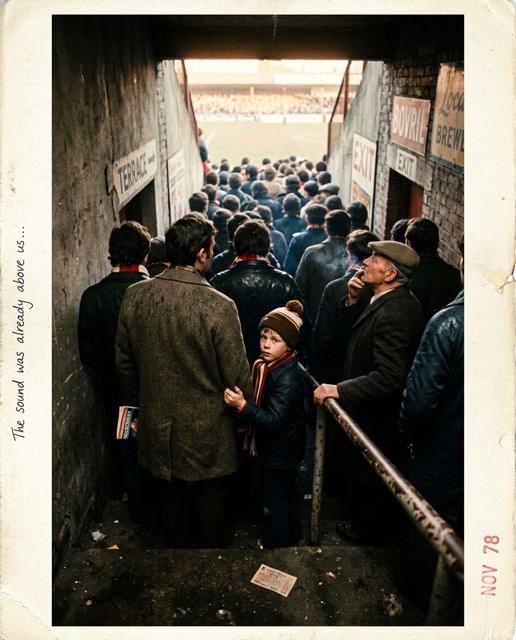
In old grounds, that first song travelled differently. It did not move across individual seats and polished concrete. It rolled through standing bodies. It found pressure points in the crowd. It gathered mass as it passed from one section to the next. The terraces were not comfortable, but they were efficient instruments. Bodies packed closely together make sound behave differently. Shoulders touching, feet braced on steps, railings in front, breath visible in winter, hundreds of people facing the same grass with the same impatience — the song did not need to be perfect. The architecture helped it become heavy.

There were people who understood this better than anyone.

The One Who Begins

Not the loudest man, necessarily.
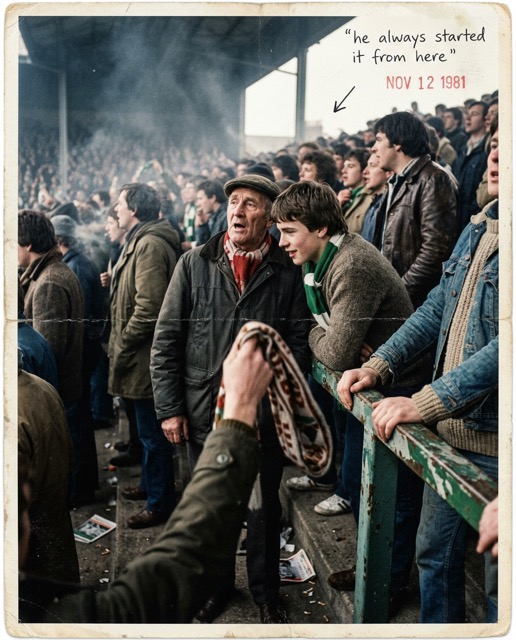
The one who knew when to begin.

No title. No armband.
A sense of the crowd sharper
than anything in the programme.

He knew when the ground was ready. He knew when the murmur had become too restless to remain a murmur. He knew when to give it shape.

The older supporter who starts the first song

Those people were rarely remembered by name. Football history does not know what to do with them. It remembers managers, scorers, captains, chairmen, sometimes even referees. It almost never remembers the man who started the first song on a grey afternoon when the club needed reminding what it was. But inside the culture of a ground, people like that mattered. They were part of the machinery of belonging. Without them, the crowd would still exist. With them, the crowd became aware of itself.

A song also changes time. Until it begins, the minutes before kickoff can feel loose and scattered. People drift. The stadium waits. The scoreboard counts down in its own indifferent way. Once the first song rises, time tightens.

Pulled upward toward the terrace before seeing the pitch

Summoned

The match is pulled closer.
The body understands that something
has started — even if the referee
has not yet blown his whistle.

The players warming up hear it and are no longer simply preparing. They are being summoned.

The match is pulled closer. The body understands that something has started, even if the referee has not yet blown his whistle. The players warming up hear it and are no longer simply preparing.

That word matters: summoned.

A true football song is not background music. It is a call. It calls the players toward courage, or at least toward responsibility. It calls the crowd toward memory. It calls the day toward seriousness. It says that the match is about to become more than scheduled entertainment. It is about to test something that people have carried into the ground whether they admit it or not.

This is why the first song can be moving even when the words are ordinary. Many football songs are not poetry on the page. Some are crude. Some are repetitive. Some make very little sense outside the ground. Written down, they can look small. Sung by thousands at the right moment, they become enormous. Football has always understood that meaning does not live only in words. It lives in repetition, timing, volume, location and the bodies producing it together.

A simple line, sung badly by one man, is almost nothing.

The same line, taken up by a stand just before kickoff, can make a stadium feel as if it has remembered its purpose.

There is also a tenderness hidden inside it, though football rarely names it that way. When people sing together before a match, they are admitting dependence. They are saying they cannot carry the afternoon alone. The old supporter needs the young voices near him. The child needs the adults to show him when to join. The players need the sound behind them. The song needs everyone. It is a small rehearsal for the truth of football itself.

No one belongs alone.

That may be why the first song stays in memory longer than the match sometimes. Scores fade. Lineups blur. The table moves on. But people remember the moment the ground lifted. They remember looking around and seeing mouths open. They remember feeling embarrassed for half a second before singing anyway. They remember the cold rail under their hands, the scarf against their neck, the old man two rows down who knew every word, the sudden awareness that they were inside something older than themselves.

For some, that is the moment they became supporters in the real sense. Not when they chose a club. Not when they bought a shirt. Not when they learned the names. But when they first added their own voice to a sound already waiting for them.

The modern game can still produce that moment. It has not disappeared. No business model has fully killed it, no stadium redesign has entirely managed it out, no screen has replaced the need for it. But it is more fragile now because so much around football is designed to make supporters behave like audiences. Audiences watch. Supporters alter the room. The first song is proof that the difference still matters.

It is also proof that the matchday archive cannot begin at kickoff. By then, too much has already happened. The week has ended. The walk has been made. The turnstile has clicked. The ground has swallowed people into its concrete. And somewhere, before the teams come out, a voice has risked the first line.

Maybe it catches.

Maybe it fails.

But when it catches, the transformation is immediate. The stadium stops waiting and begins remembering. The air takes shape. The match, still technically unstarted, has already entered the people who came to live it.

That is why the first song matters.

Not because it is loud.

Because it turns everyone toward the same feeling before the game has given them anything in return.
Share This Archive
Reddit X WhatsApp
Previous in the Archive
When The
Turnstile Clicks
Archive 005  ·  Ritual & Threshold  ·  8 min read