A football match does not always end when the stadium empties.
Sometimes it follows people home.
It sits in the back seat of the car without speaking. It travels on the late train with scarves folded into laps and programmes tucked into coat pockets. It waits at the kitchen table while someone makes tea too late at night. It lies awake beside the supporter who promised himself not to think about the missed chance and then thinks about it anyway, again and again, with the useless precision of regret.
By Monday morning, the official matchday is over. The gates are locked. The terraces are empty. The pitch has been cleared of bodies and noise. The old paper cups have been swept away, the programme sellers are gone, the floodlights are cold, and the stadium has returned to being a building.
But the score is not finished.
It has moved into ordinary life.
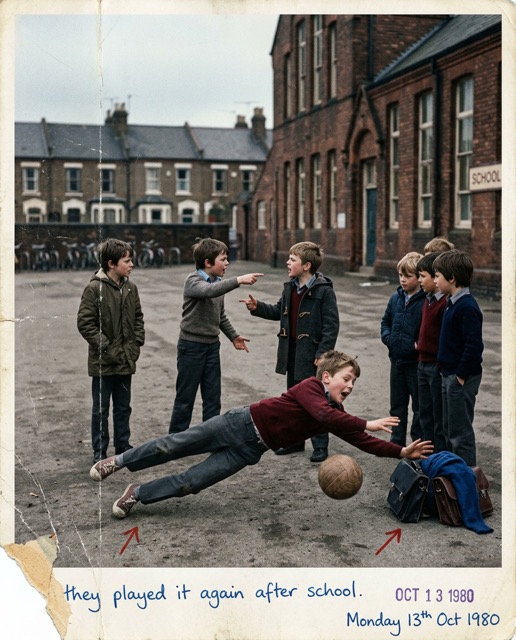
That is one of football’s quieter powers. It refuses to remain inside its scheduled time. A match played on Saturday afternoon can alter the temperature of Sunday dinner, the mood of a shift, the silence between friends, the walk to school, the way a man opens a newspaper, the way a child repeats a goal in the garden with a ball that does not bounce properly. Football enters the week disguised as memory, irritation, pride, embarrassment, hope, argument and ritual. It changes nothing official, and yet it changes the air.
Monday is where that becomes visible.
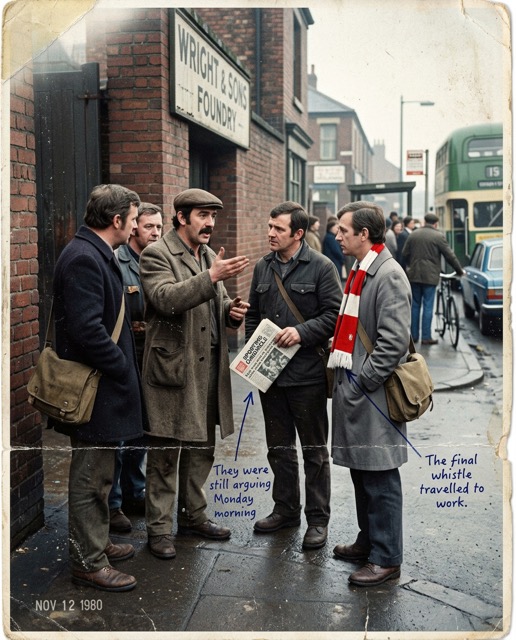
The world expects people to return. Work begins. Buses arrive. Shops open. School bells ring. Factory gates take men back in. Offices fill. Streets that were painted by matchday colours two days earlier are now grey with routine. Football, officially, has no right to dominate anymore. But it does. Not loudly, not everywhere, not in the theatrical way it does inside a ground. It dominates through fragments.
A headline on the back page.
A scarf still hanging over the chair.
A hoarse voice at breakfast.
A boy wearing his shirt under his school jumper.
Two men at a bus stop beginning with the weather and ending with the referee.
A woman behind a counter asking, without needing to name the match, “What happened to you lot?”
Monday knows.
It always knows.
In older football towns, the Monday after a match had its own public language. Before phones carried highlights in every pocket, the result travelled through newspapers, radio, workplaces, classrooms, pubs, factories and shop counters. People who had been there became witnesses. People who had not been there became interrogators. The match was reconstructed in pieces across the town by those who claimed the best view, the clearest memory, the strongest grievance or the right to speak because they had stood in the rain to see it.
The result alone was never enough.
A scoreline is a skeleton. Monday put flesh back on it.
It asked how the goal happened, whether the keeper should have saved it, who lost his man, who played better than the papers said, whether the new signing was soft, whether the old centre-half was finished, whether the manager had seen what everyone else had seen by the twenty-fifth minute. It turned one match into a thousand retellings, and in doing so it extended matchday beyond the ground.
This mattered because football has always depended on repetition after the event. The match is lived once, but it becomes culture by being retold. In the stands, people experience it together. On Monday, they test what it meant. They argue it into shape. They decide which moments will survive and which will disappear. A great goal may not become great until enough people describe it that way. A bad defeat may become worse on Monday because shame needs witnesses. A lucky win may become heroic by lunchtime if enough supporters agree to ignore the evidence.
Football memory is not neutral. It is negotiated.
Monday is one of the places where that negotiation happens.
At work, the match entered before the worker did.