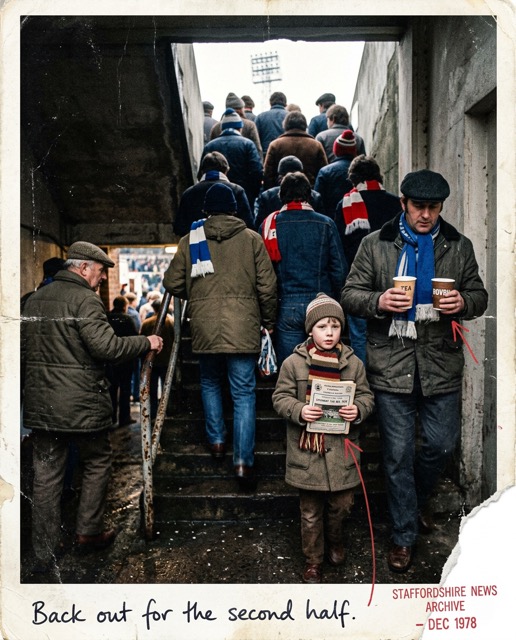
The walk away from the pitch is scattered, but the walk back toward it has gravity. People drain the last of their tea, throw cups into bins or near bins, button coats, wipe hands, finish cigarettes, check the time, and begin moving upward again. The concourse noise narrows. The stairs pull people back toward the light. The rectangle of the pitch reappears at the end of a passage or above the last concrete steps, and with it returns the strange vulnerability of caring.
In old stadiums, the second half often announced itself before the players returned. The crowd would arrive back unevenly, with pockets of song, whistles, laughter, last complaints, the scrape of feet, the sudden roar when the first player appeared from the tunnel. The ground gathered itself again. A man who had spent halftime declaring the team hopeless would be the first to shout encouragement. Another who had sworn not to watch any more would lean forward as soon as the ball was placed.
Football forgives hypocrisy because it understands dependence.
Halftime reveals that dependence with unusual clarity. Supporters may speak about tactics, substitutions and referees, but what they are really managing is emotional exposure. The first half has opened them. The second half may reward them, embarrass them, punish them or give them something they will talk about for years. The break is where they prepare to be hurt again.
That is not melodrama. It is the ordinary risk of support.
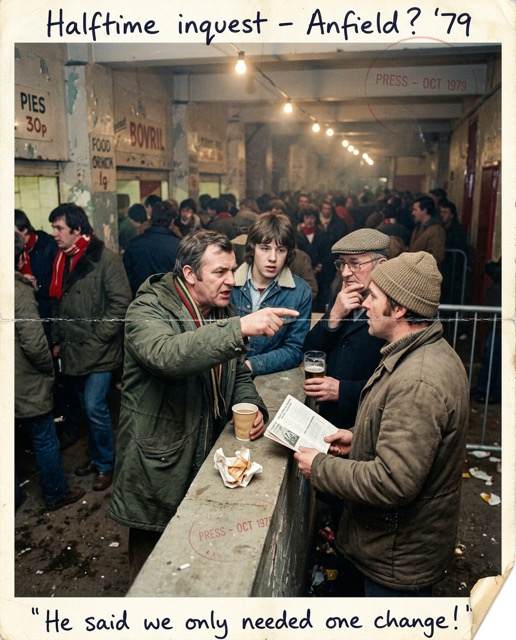
To people outside football, halftime can look like a pause filled with practicalities: bathroom, food, drink, conversation. But those rituals are not separate from the match. They are how the match is metabolized. A cup of tea at halftime is not just a cup of tea. It is warmth against frustration. A cigarette is not just a cigarette. It is a way of standing still with nerves. A queue is not just a queue. It is a temporary parliament of people who have no authority and endless opinions. The concourse is not outside the match. It is the match passing through human bodies.
This is why old halftime photographs matter. They rarely show the famous parts of football. No goals, no tackles, no captains, no trophies. Instead, they show men with cups in hand, boys standing close to fathers, women in coats talking under poor light, supporters reading programmes, stewards watching doors, cigarette smoke hanging under concrete, faces turned toward radios, strangers arguing with the intimacy of people who may never learn one another’s names.
Those images are not secondary.
They are the evidence that football was never only on the grass.
Halftime is where the stadium admits what it really is: not just a place for watching, but a place for processing collective emotion. The first half enters the crowd and comes back out as speech, ritual, anger, laughter, superstition and renewed hunger. The second half is not simply played after halftime. It is partly created by what the ground becomes during those fifteen minutes.
A team can return flat and find the crowd waiting coldly, arms crossed, patience gone. A team can return to a noise rebuilt in the concourse, a stand that talked itself back into faith. Sometimes the players feel it. Sometimes they do not. Sometimes the crowd lies to itself and the match exposes the lie within five minutes. Sometimes the lie becomes useful enough to turn into truth.
Nothing has happened
and everything has happened.
No goal has been scored during the interval. No point has been won. No table has changed. But the emotional direction of the afternoon may have shifted completely. A crowd can return heavier, lighter, angrier, braver, quieter or more dangerous than it left. The match resumes on the pitch, but something resumes in the stands too.
The whistle to restart is never just a continuation.
It is a second beginning.
This is why halftime belongs in the archive. Modern football cuts it into advertising, analysis, graphics, highlights and studio certainty. It turns fifteen minutes into a broadcast asset. But the lived halftime was always messier and more important than that. It belonged to corridors, queues, hands around cups, arguments under concrete, fathers explaining badly, strangers disagreeing intensely, old men remembering older teams, children watching adults care too much and learning that this was part of the inheritance.
The matchday story would be false without it.
Because the first half tells supporters what the afternoon is becoming.
Halftime tells them what they are willing to carry into the rest of it.
And when they return to the stand, when the players come back out, when the pitch reclaims the eyes of everyone inside the ground, the break disappears as if it had been nothing.
But it was not nothing.
It was where the day was repaired, or failed to be.
It was where the second half was imagined before it arrived.
It was where hope, wounded or ridiculous, stood in a queue under bad light and decided to go back out again.