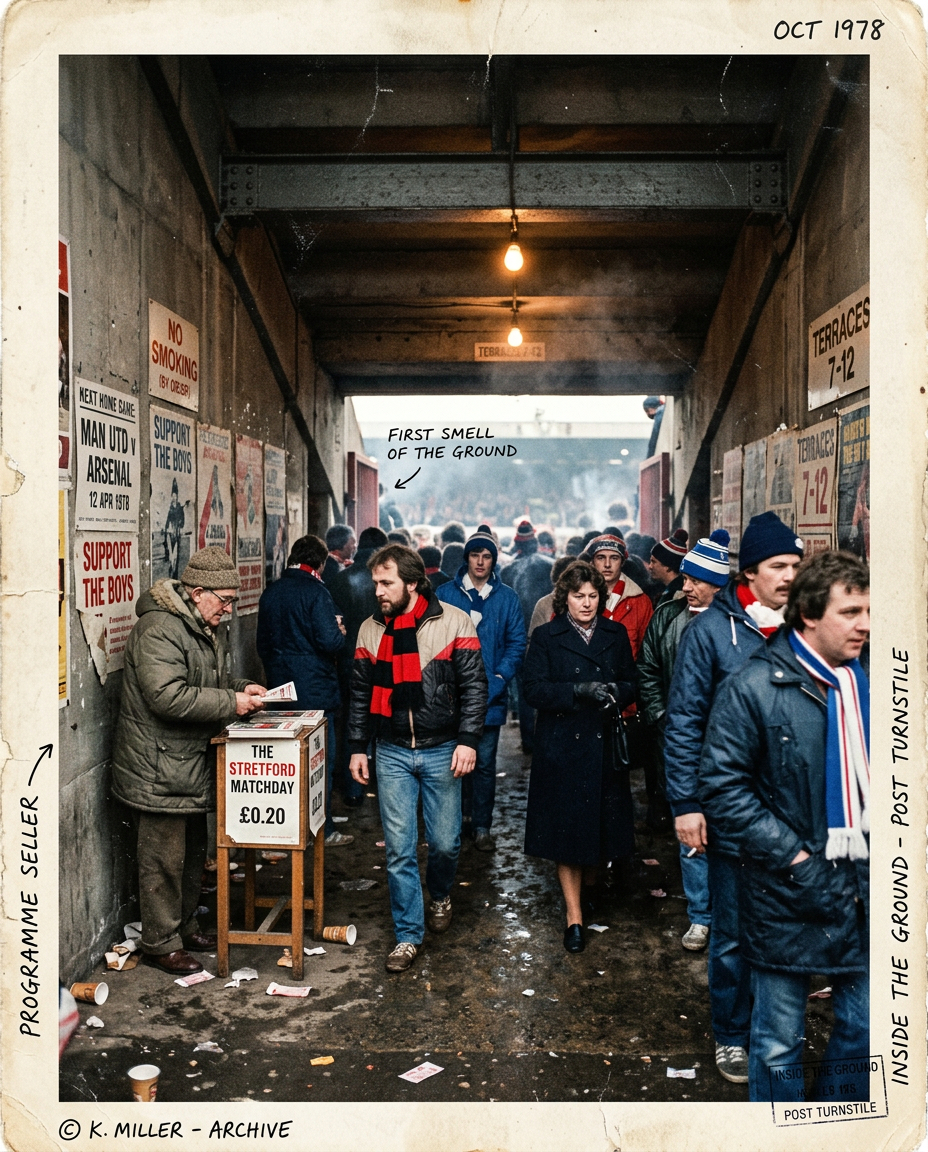
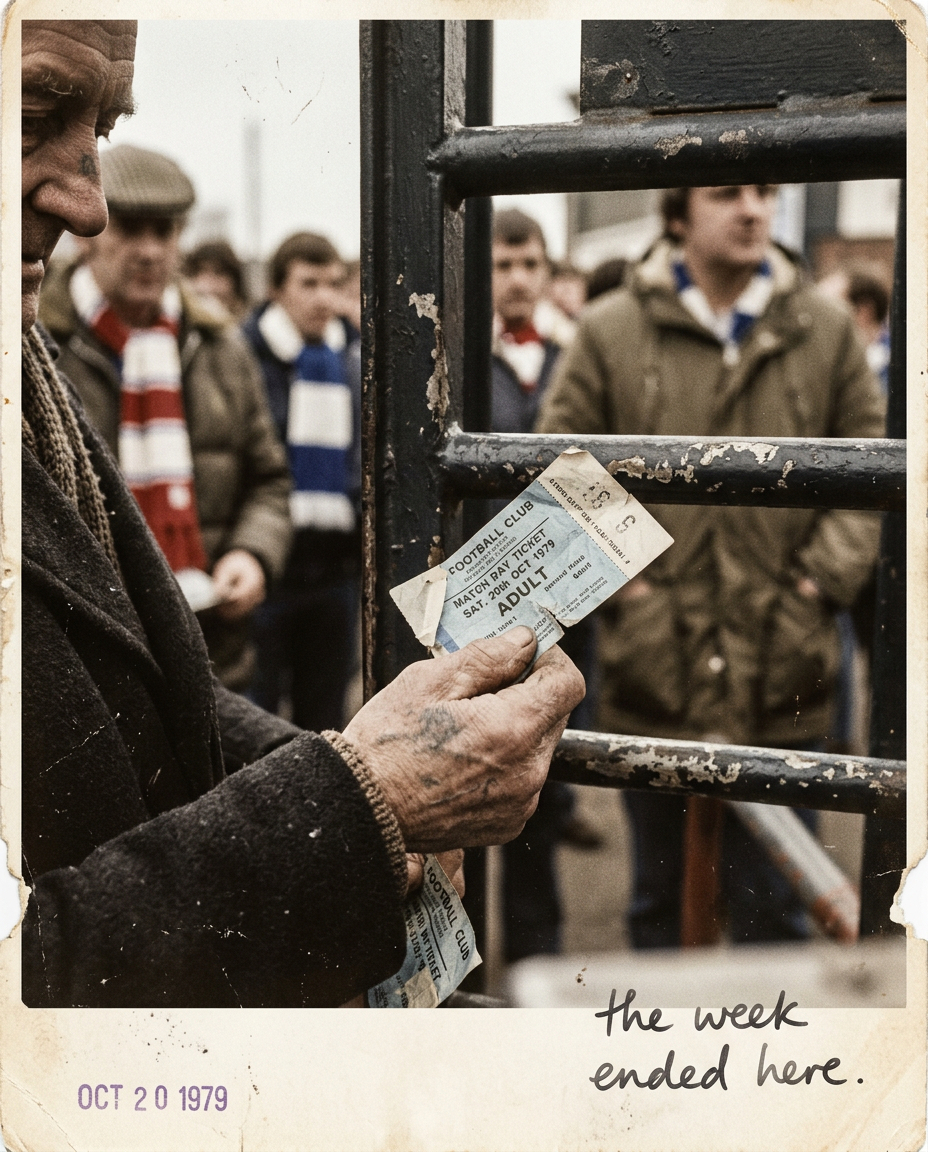
Today, football entry is often silent. A barcode flashes green. A phone screen lights up. A gate slides open. It is efficient, almost invisible. But older grounds announced your arrival in harder terms. You fed the system something physical — a paper ticket, a stub softened by being carried in a pocket all morning, a coin in even earlier times — and the ground answered back with resistance, then permission. You felt it in your hand, in your shoulder, in the half-turn of your body as you pushed through. A machine had let you in, but it never felt mechanical. It felt ceremonial.
The turnstile mattered because football has always depended on transitions. The walk to the ground is one of them. The first pint before the match is another. The first sight of the crowd gathering outside the stadium, scarves appearing in side streets and near station exits, is another still. But none of them is final. All of them can still be interrupted. You can still go home. You can still be delayed. You can still remain outside. The turnstile is where possibility ends.
Once it clicks,
you belong to the afternoon.
That sound was not dramatic. No orchestra followed it. No lights dimmed. No voice announced that your ordinary life had been temporarily suspended. But for those who went every week, none of that was necessary. The body already knew. You joined the queue with one mood and passed through with another.
Even children understood it. Outside the ground they walked beside their fathers or older brothers or uncles, distracted by programmes, cigarette smoke, vendors, police horses, puddles, cold fingers. Inside, something tightened. They stood up straighter. They looked around more carefully. They had arrived at the place where the day would now be decided.
A turnstile is an unromantic object. Heavy metal. Grease. Scratches. Paint wearing away at the points of contact. It belongs to utility, not poetry. Yet football has always turned practical objects into emotional ones. Scarves were only knitted fabric until they began to mean inheritance. Match tickets were only paper until people kept them in drawers for twenty years. Programmes were only folded print until they became evidence that somebody had been there. The turnstile belongs to that same class of object: humble, repetitive, almost ugly, and charged with far more feeling than it was ever designed to carry.
Part of its power came from repetition. The turnstile did not matter because you passed through it once. It mattered because you passed through it a hundred times, then a thousand. Because over years it became the same beginning to different matches and different seasons and different versions of yourself. There were men who could have recognized the exact gate they used by touch alone. They knew which one stuck in wet weather, which one squealed when the crowd pushed too hard, which one the club always seemed slow to repair. These details are invisible to official history, but they are how supporters actually remember football. Not as a clean sequence of results, but as a map of entrances, corners, smells, sounds and habits.
The turnstile also performed one of football’s oldest tricks: it reduced difference. Outside the ground, people arrived carrying different weeks. One had been laid off. One had been promoted. One had argued with his wife. One had spent the morning fixing a boiler. One had travelled across town in his only coat. One had brought his son for the first time. The turnstile did not ask for biography. It asked only for admission. You offered proof that you had the right to be there, and then you were absorbed into a larger body. That small act of compression — from individual life into shared belonging — is one of the deepest pleasures football offers, and the turnstile was its instrument.
There was also something honest about its physicality. Older football did not hide its boundaries. You knew when you were outside and when you were in. You knew what it cost. You knew what it demanded. You queued in rain. You waited in cold. You were pressed shoulder to shoulder with strangers before you ever reached the terrace. By the time you entered, you had already paid a small bodily price. That mattered. Not because suffering is noble, but because effort increases meaning. Football was not delivered to you frictionlessly. You went to meet it.
Once through, everything sharpened. The sound changed first.