The match is pulled closer. The body understands that something has started, even if the referee has not yet blown his whistle. The players warming up hear it and are no longer simply preparing.
That word matters: summoned.
A true football song is not background music. It is a call. It calls the players toward courage, or at least toward responsibility. It calls the crowd toward memory. It calls the day toward seriousness. It says that the match is about to become more than scheduled entertainment. It is about to test something that people have carried into the ground whether they admit it or not.
This is why the first song can be moving even when the words are ordinary. Many football songs are not poetry on the page. Some are crude. Some are repetitive. Some make very little sense outside the ground. Written down, they can look small. Sung by thousands at the right moment, they become enormous. Football has always understood that meaning does not live only in words. It lives in repetition, timing, volume, location and the bodies producing it together.
A simple line, sung badly by one man, is almost nothing.
The same line, taken up by a stand just before kickoff, can make a stadium feel as if it has remembered its purpose.
There is also a tenderness hidden inside it, though football rarely names it that way. When people sing together before a match, they are admitting dependence. They are saying they cannot carry the afternoon alone. The old supporter needs the young voices near him. The child needs the adults to show him when to join. The players need the sound behind them. The song needs everyone. It is a small rehearsal for the truth of football itself.
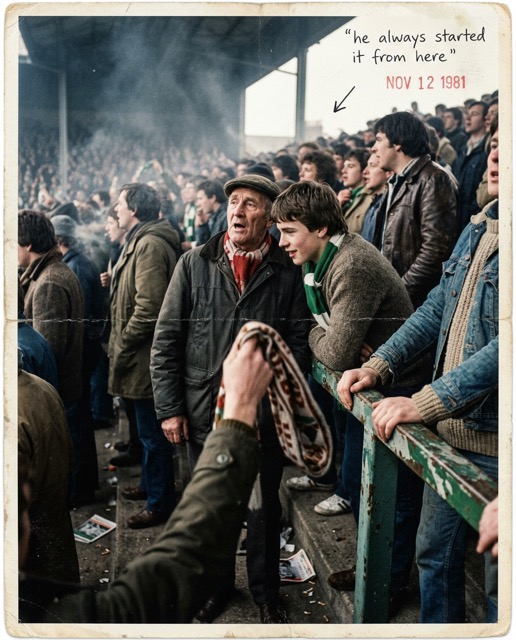
That may be why the first song stays in memory longer than the match sometimes. Scores fade. Lineups blur. The table moves on. But people remember the moment the ground lifted. They remember looking around and seeing mouths open. They remember feeling embarrassed for half a second before singing anyway. They remember the cold rail under their hands, the scarf against their neck, the old man two rows down who knew every word, the sudden awareness that they were inside something older than themselves.
For some, that is the moment they became supporters in the real sense. Not when they chose a club. Not when they bought a shirt. Not when they learned the names. But when they first added their own voice to a sound already waiting for them.
The modern game can still produce that moment. It has not disappeared. No business model has fully killed it, no stadium redesign has entirely managed it out, no screen has replaced the need for it. But it is more fragile now because so much around football is designed to make supporters behave like audiences. Audiences watch. Supporters alter the room. The first song is proof that the difference still matters.
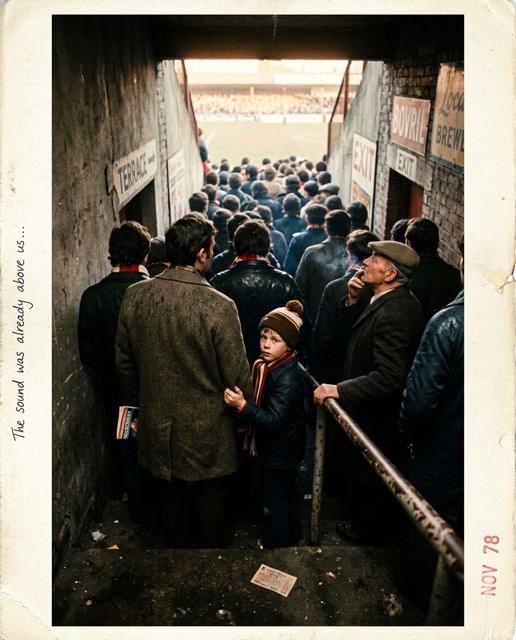
It is also proof that the matchday archive cannot begin at kickoff. By then, too much has already happened. The week has ended. The walk has been made. The turnstile has clicked. The ground has swallowed people into its concrete. And somewhere, before the teams come out, a voice has risked the first line.
Maybe it catches.
Maybe it fails.
But when it catches, the transformation is immediate. The stadium stops waiting and begins remembering. The air takes shape. The match, still technically unstarted, has already entered the people who came to live it.
That is why the first song matters.
Not because it is loud.
Because it turns everyone toward the same feeling before the game has given them anything in return.