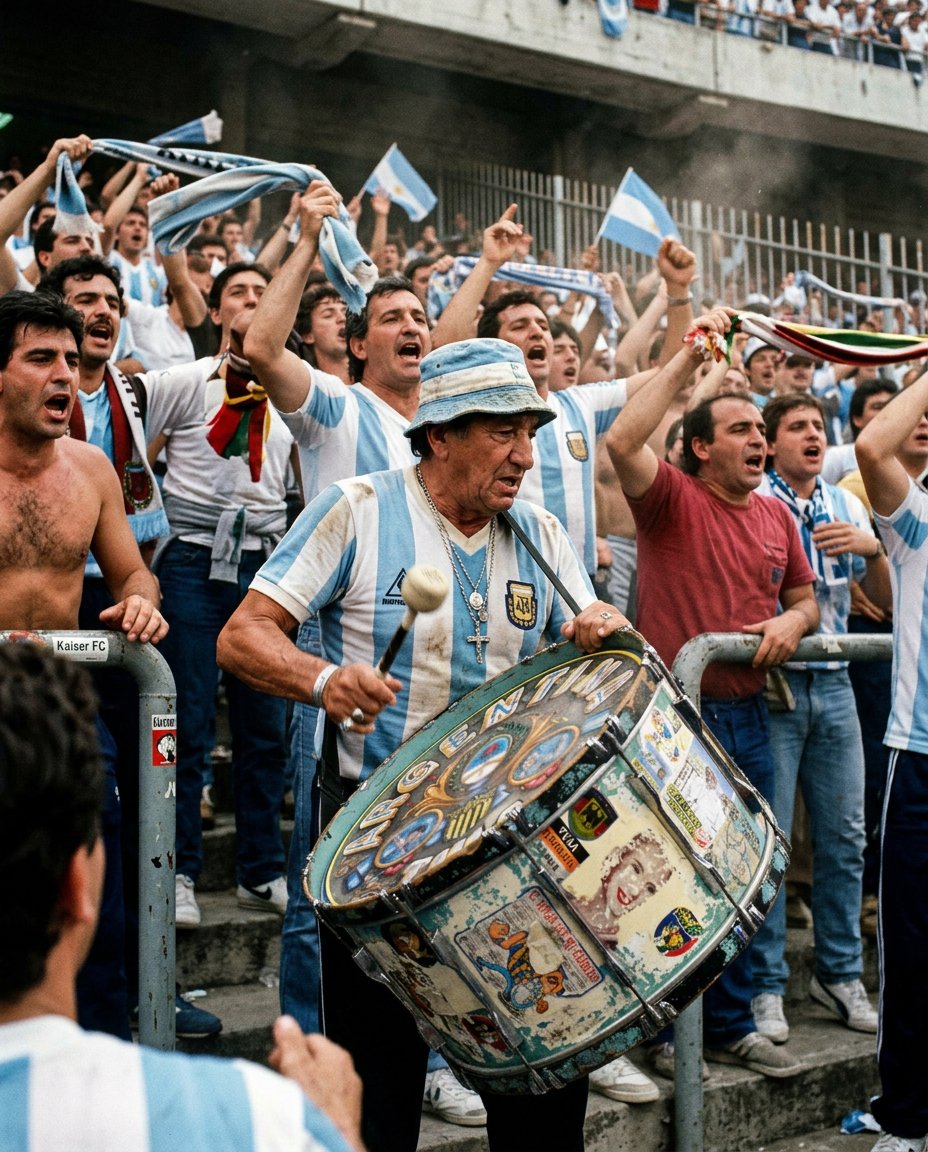
The drum that crossed the world therefore deserves to be understood not simply as an object, but as a cultural turning point. It helped transform the national-team supporter from spectator into visible protagonist.
The World Cup had always been a competition between countries. The travelling drum announced that it was also a competition between ways of supporting. Which nation would sing longest, travel hardest, occupy public space most vividly, impose its sound on neutral streets and leave the deepest trace behind?
Long before social media turned every fan into a potential broadcaster, some supporters had already figured out how to make themselves unforgettable.
There is also something deeply moving in the physicality of the thing.
A scarf folds into a pocket.
A badge sits on a jacket.
A ticket stub can be forgotten inside a drawer.
A drum demands commitment.
It has weight. It takes up space. It makes modest travel more difficult. It asks its owner to commit not only emotionally but practically — to carry it when he is tired, protect it when he is drunk, find somewhere to put it when he sleeps, explain it when challenged, and trust that the absurdity of all that effort will be redeemed once the chanting starts.
Football culture is built from unnecessary commitments made necessary by love.
The great objects of the game are rarely the most expensive ones. They are the ones that absorb life.
A cap with thirty summers in it.
A scarf that smells faintly of smoke and rain no matter how many times it is washed.
A flag whose stitching has been repaired more often than anyone admits.
A drum with cracked paint, tightened ropes, dented hardware and a shell full of accumulated miles.
Objects like that stop being accessories. They become witnesses.
Seen that way, the drum belongs to the same emotional family as the old terrace, the inherited shirt and the seat by the television that nobody else took during a tournament. It is part of the architecture of football memory.
Not official memory, which prefers medals and record books — but lived memory. The memory that remembers where the sound came from, who started the chant, which square first began to fill two hours before kickoff, and which supporter could be heard above the rest when the team needed belief more than melody.
That is why this story still matters now. Modern football often pretends atmosphere appears by itself, as if noise were a natural by-product of ticket sales and event lighting.
It is not.
Atmosphere is made.
It is carried.
It is organised by people who care enough to arrive with more than their own body.
The drum is one of the purest examples of that labour. It turns support into work of a beautiful kind — repetitive, exhausting, communal work performed for no salary and no guarantee of reward.
And yet the reward is obvious to anyone who has stood inside a great matchday crowd when the first beat begins.
Bodies align.
The terrace wakes up.
Strangers recognise one another without needing introductions.
A nation far from home suddenly sounds like itself again.
That is what crossed the world. Not wood and rope alone — but a way of making belonging audible.
Some World Cup stories belong to goals. Some belong to shirts. Some belong to streets, bars, radios, fathers and televisions left on too late into the night.
This one belongs to the people who understood that football is not only watched.
It is announced.
It is carried into the day with both hands.
It is beaten into life loudly enough that everyone nearby must decide whether they want to join — or get out of the way.
The drum crossed the world
because silence
was never going to be enough.