01 — The AllegationWhat the record cannot explain
Marco Franchi was not moving through Italian football because clubs needed his football. He was being moved because his registration, his contract or the transaction surrounding him served another purpose.
Perhaps he carried value that did not appear in his wages.
Perhaps his transfers connected presidents who could not be seen dealing directly with one another.
Perhaps he was a convenient name through which favours, obligations or money could pass.
Perhaps he knew exactly what he was doing. Perhaps he knew nothing.
The surviving record proves only that nine clubs signed him. It does not explain why.
02 — The First ContractSanremo, November 1958
The paperwork begins in Sanremo. On 8 November 1958, A.C. Portosole 1948 registered a twenty-year-old centre-forward from Chiavari named Marco Franchi. Nothing in the surviving club record suggests urgency.
Portosole already had four recognised forwards. Franchi had no significant senior experience. There is no preserved scouting report, recommendation letter or trial assessment attached to the agreement. The contract was prepared more than three hundred kilometres away in Modena by Studio Legale Baldini & Rovere.
At the bottom of the final page, beneath the signatures of the player and the club president, appeared the countersignature of the firm's senior partner:
E. S. Baldini
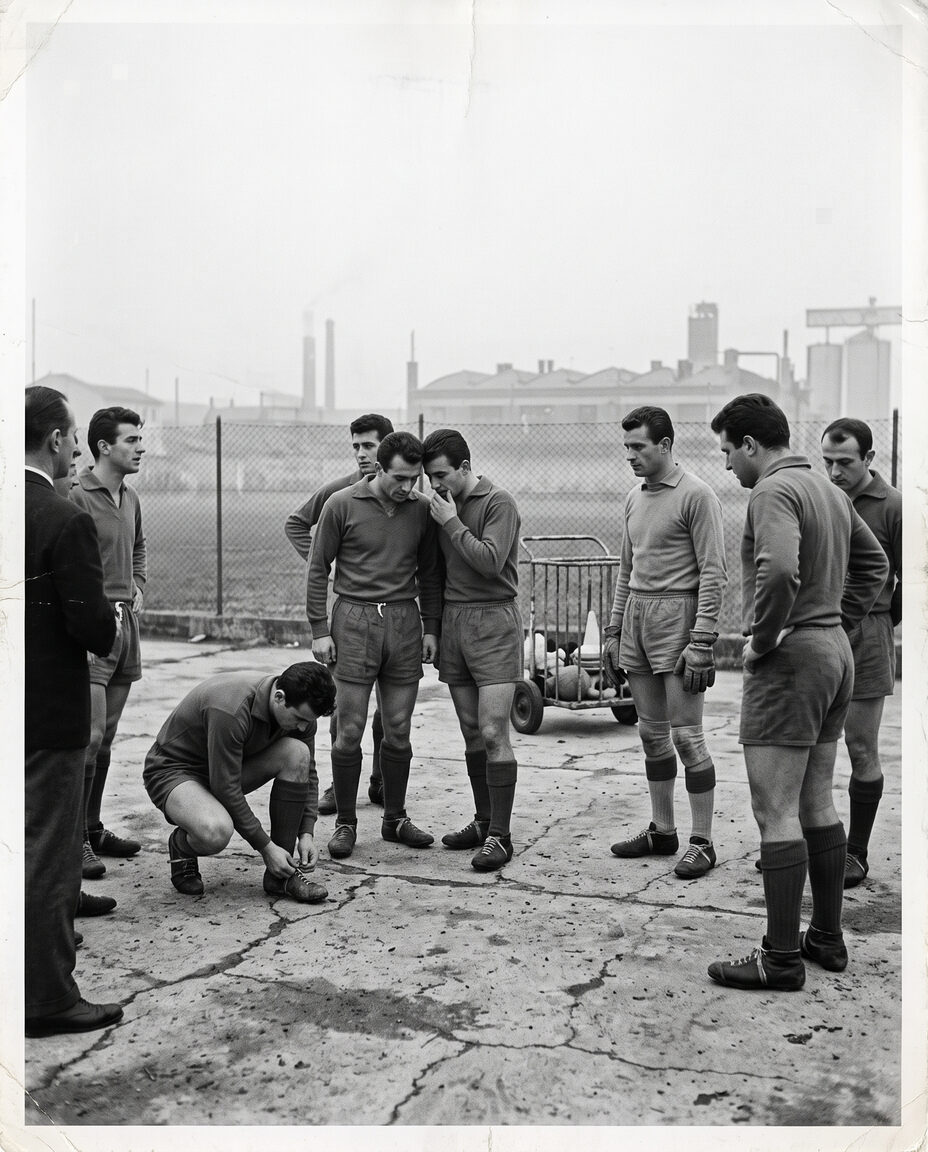
Franchi played six league matches. He scored once. Exactly one year later, during the same week in November, U.S. Riviera 1932 registered his second contract. The president changed. The club changed. The city changed.
The lawyer did not.
03 — The PatternThe safest place for a secret
By 1961, Franchi had signed four contracts in four years. Every agreement was deposited between 6 and 12 November. Every agreement had been prepared or reviewed by Baldini's office. The clubs had little else in common.
Some were fighting relegation. Others were pursuing promotion. One needed an experienced reserve. Another claimed to be investing in youth despite signing Franchi at twenty-five. His sporting value never became clear.
He was not fast enough to change matches.
He was not prolific enough to justify repeated transfers.
He was not famous enough to sell tickets.
He was not controversial enough to attract investigation.
That may have been his greatest value.
Marco Franchi occupied the safest place for a secret in professional football: the middle of the squad list. Stars attract cameras. Failures attract questions. Franchi attracted neither.
He trained. He appeared occasionally. He left. Then another contract arrived.
04 — The Man in the Grey OvercoatThree dressing rooms, one figure
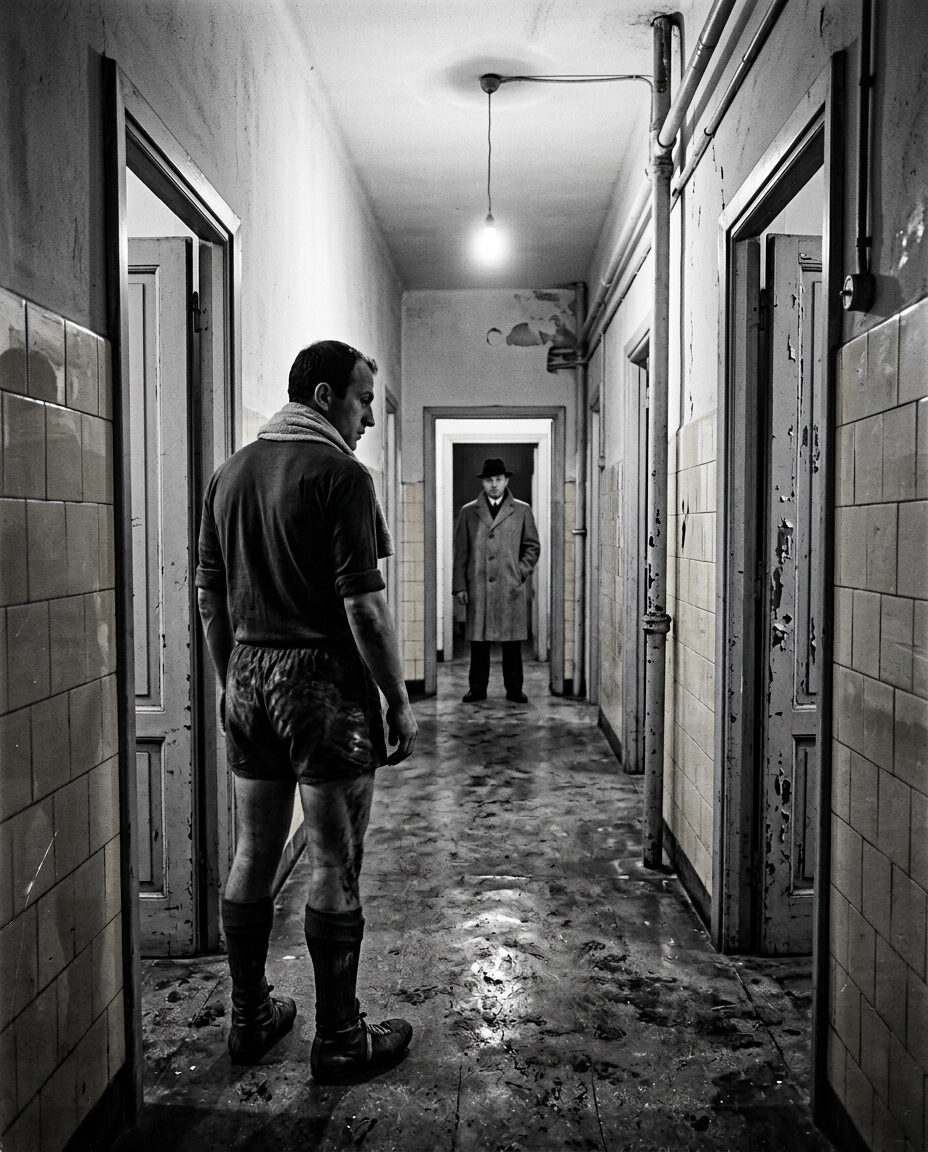
The first account appeared years later, in the testimony of a former Circolo Sportivo Valpadana defender. After a home defeat in November 1962, he remembered seeing a man waiting near the dressing-room corridor.
The man wore a grey wool overcoat.
He carried no notebook.
He wore no club scarf.
He did not appear to have watched the entire match.
When most of the players had left, Franchi stepped into the corridor. The conversation lasted less than two minutes. The man departed through the players' entrance. Franchi returned to the dressing room. No introduction was made.
Two similar accounts later emerged from different clubs. One placed the same figure outside A.S. Termini Bianchi's dressing room in Rome. Another remembered him beside the team bus during Franchi's period with U.S. Adriatica 1928. The descriptions were not identical. Memory rarely is. But all three accounts agreed on four details: the grey coat, the absence of club colours, the brief private conversation — and the fact that the man always appeared shortly before another contract was registered.
His identity never entered the official record.
05 — The Missing YearsPages that no longer exist
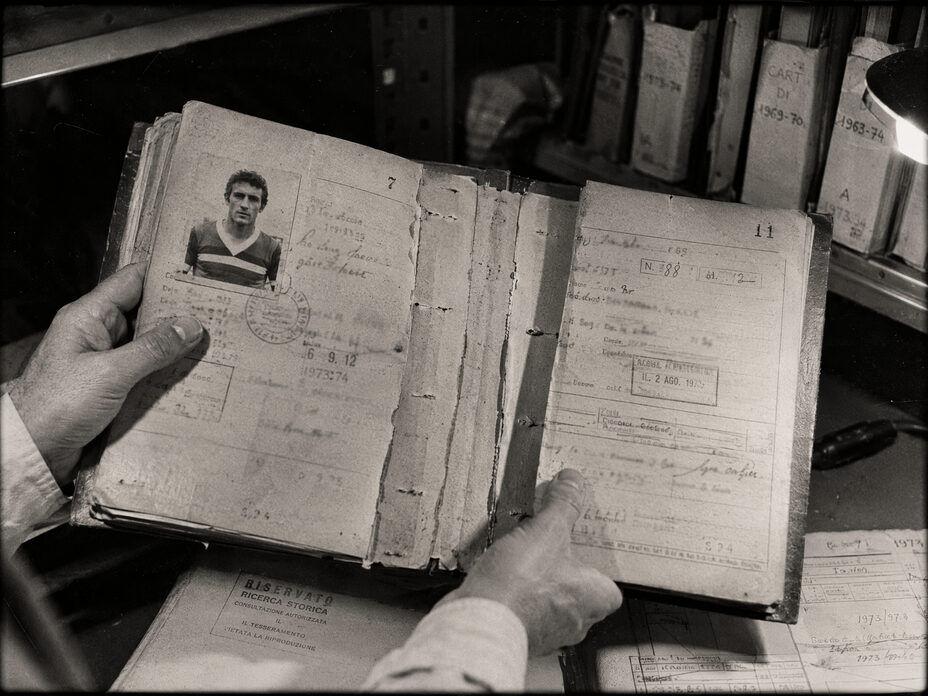
Franchi's surviving federal file contains fifteen pages. The pages are numbered consecutively from one to eighteen. Pages eight, nine and ten are absent. They were not renumbered. They were not replaced.
“Materiale non disponibile per consultazione.”Material unavailable for consultation. — Federal archive annotation
The missing section covers the period between 1963 and 1965. Those were the years in which Franchi left Liguria, signed for A.S. Termini Bianchi on the outskirts of Rome and later moved to U.S. Adriatica 1928.
His appearances can be reconstructed from match reports. His contracts can be identified through club registers. What cannot be reconstructed is the reason for either move. The pages immediately before the missing section contain routine registration material. The pages immediately after it resume with another contract carrying Baldini's countersignature.
Nothing explains who removed them. Nothing establishes what they contained.
06 — The Ninth ContractCastelvetrano, November 1969
On 10 November 1969, S.S. Belice 1928 registered Marco Franchi as an experienced centre-forward. He was thirty-one. He had scored seven professional goals. The registration was prepared by Studio Legale Baldini & Rovere. It was Franchi's ninth contract and his eighth transfer.
By then, the pattern had existed for eleven years. Different clubs. Different presidents. Different regions. The same week in November. The same office in Modena. The same countersignature beneath every agreement.
Franchi made three appearances for Belice. He did not score. In June 1970, he retired without a testimonial, interview or public statement. He returned to Genoa and opened a small home-appliance shop on Via San Vincenzo. For the next forty-one years, he sold radios, washing machines and television sets.
No known journalist asked him about the nine contracts. No former president publicly explained them. Emilio Sanzio Baldini died in 1979. His legal practice closed within months. Marco Franchi died in 2011.
The three pages remained unavailable.