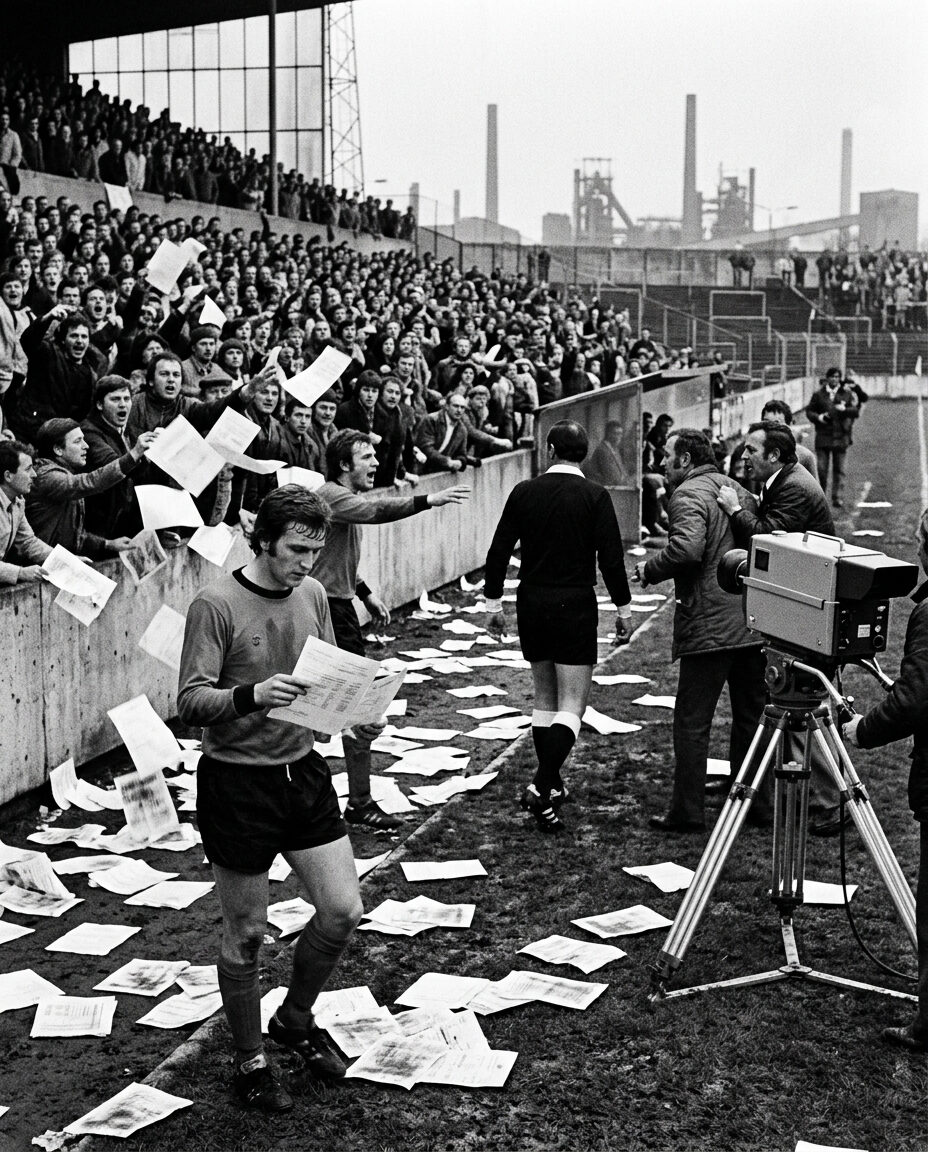
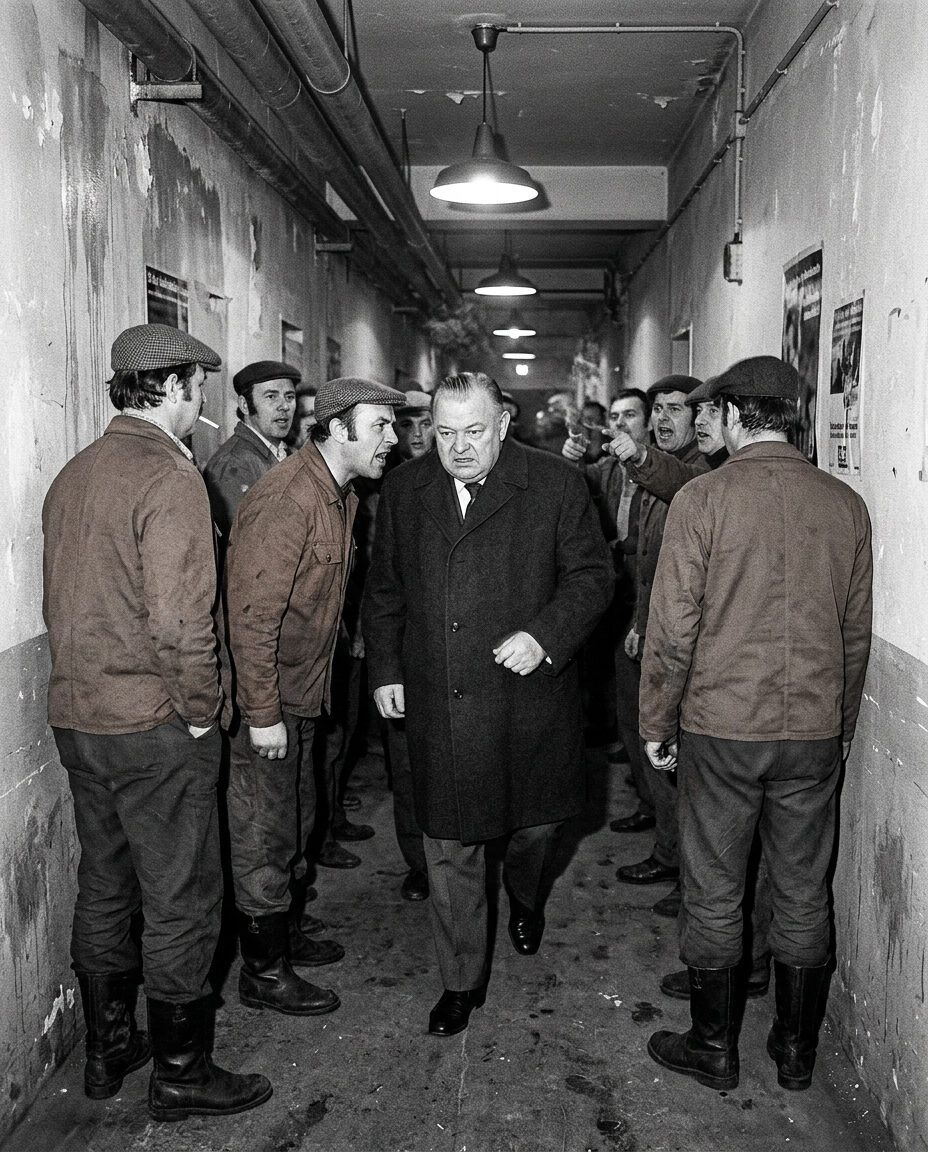
01 — The AllegationHe built his presidency around them
Walter Kettler did not merely tolerate Die Braune Kurve. He built his presidency around it. The group acted as an unofficial enforcement arm for VfB Waldstadt:
- controlling access to member meetings;
- intimidating internal opponents;
- threatening players who criticised the board;
- attacking rival supporters;
- protecting directors from demonstrations;
- deciding which voices could survive inside the home terrace.
Kettler paid for the structure while denying that it existed. The arrangement continued until he attempted to sacrifice the group in exchange for a stadium deal. By then, Die Braune Kurve possessed twelve years of payment records, private instructions and recorded conversations.
He believed he had purchased their loyalty. What he had financed was the organisation that would eventually remove him.
02 — The ClubThey called it die Grube — the pit
VfB Waldstadt 08 stood between a coking plant and a railway repair depot in the western Ruhr. Its stadium was officially called the Waldstadion. Nobody used that name. Supporters called it die Grube — the pit. The south terrace was steep, uncovered and permanently stained by industrial smoke.
Waldstadt was not a successful club. It moved repeatedly between the second and third levels of West German football. Its identity did not come from trophies. It came from resistance — workers who expected institutions to forget them and considered survival a form of victory.
That identity made loyalty powerful. It also made loyalty easy to exploit.
03 — Walter KettlerHe understood movement and access
Walter Kettler became president in May 1966. He owned a regional transport company running buses between factories, mines and railway stations. He understood two systems better than football: movement and access. Who could enter. Who could travel. Who arrived together. Who was left outside.
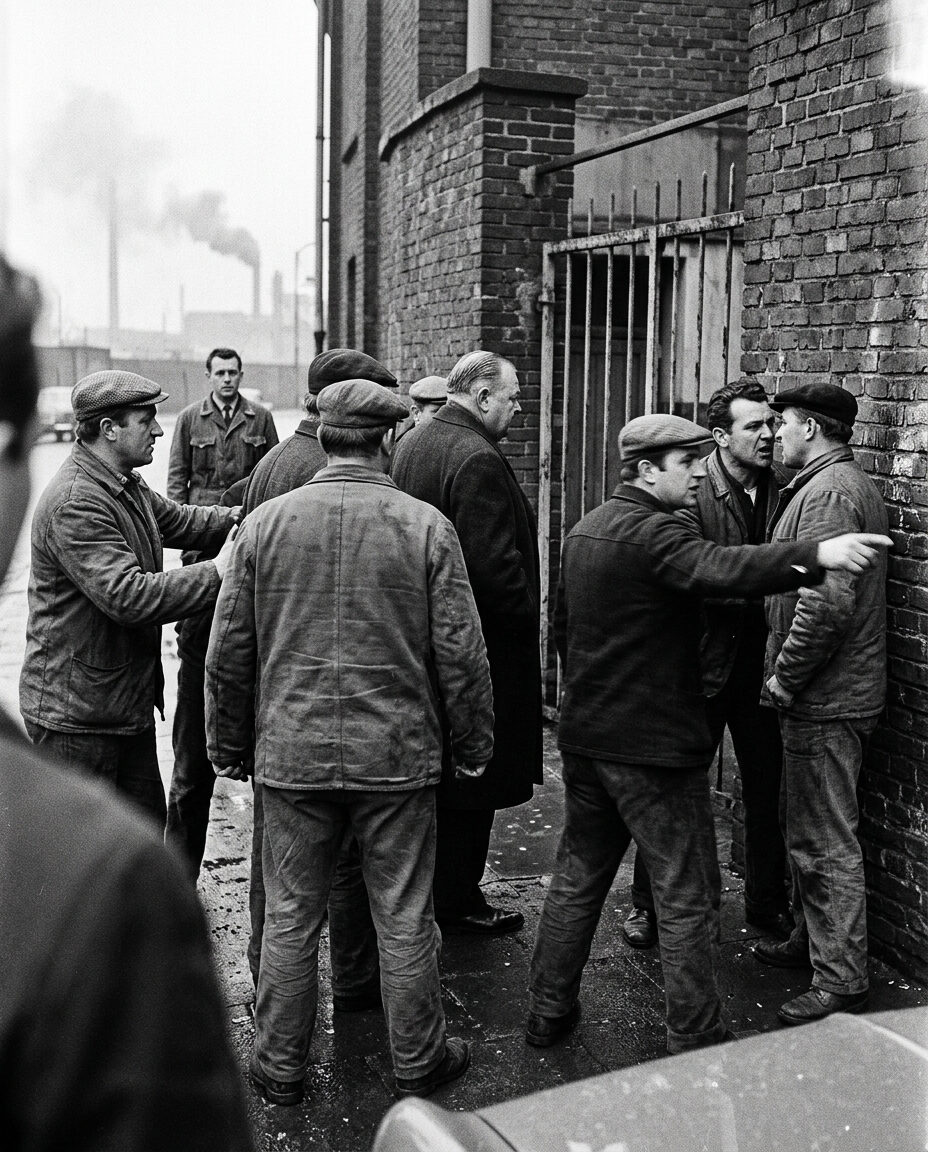
His opponents described him as a businessman trying to take private control of a members' club. The election was expected to be close. It was not. On the evening of the vote, more than two hundred members associated with the opposition found the entrance to the assembly hall blocked. Men in brown work jackets stood across the doors, inspecting membership cards, delaying some members until voting had begun.
Inside, Walter Kettler won the presidency by thirty-four votes. The club recorded no disturbance.
04 — Die Braune KurveAn industrial explanation for a political colour
Die Braune Kurve had formed two years earlier around the southern end of the stadium. The group claimed its name came from the brown jackets worn by workers from the coking plants. The explanation was not entirely false. Neither was it complete.
By the late 1960s, the group included nationalists, street fighters and men connected to radical organisations outside football. Their jackets provided an industrial explanation for a colour whose political meaning in Germany required no explanation. The club repeatedly described them as “young supporters of an emotional but apolitical nature.”
Their actions were rarely apolitical. They targeted migrant supporters. They assaulted left-wing student groups distributing leaflets outside the stadium. They displayed nationalist symbols and attacked anyone trying to remove them. Kettler never publicly defended their ideology.
He defended their usefulness.
05 — The ArrangementIt began with buses
The relationship began with buses. Kettler's company provided reduced-price transport for away matches. Then the buses became free. The group received blocks of tickets before general sale. Five members were employed as matchday security. Two received maintenance contracts. A storage room beneath the south terrace became their private meeting space. When members were arrested after away fixtures, a club solicitor occasionally appeared at the police station.
The payments were concealed beneath accounting headings such as:
youth transport
stadium stewarding
supporter liaison
emergency maintenance
away-match logistics
06 — What Protection MeantIt protected his control of the club
Die Braune Kurve did not protect the club. It protected Kettler's control of it. In 1968, members broke up a meeting of supporters opposing higher ticket prices. In 1970, a local reporter was beaten after publishing questions about payments to Kettler's transport company. In 1972, the group surrounded the car of a midfielder who had accused the board of withholding bonuses; he withdrew the accusation the next morning.
In 1974, several hundred members arrived early at the annual assembly and filled the front rows. Opposition speakers were shouted down. One was removed after being accused of insulting the club. Kettler remained seated throughout. When journalists asked whether the group had acted under instructions, he answered:
“A president cannot be responsible for every emotion inside a football ground.”He financed the logistics. They supplied the emotion.
07 — The Player Who Would Not ApologiseCaptains represent institutions, not themselves
In March 1975, Waldstadt captain Dieter Mahlberg criticised the board after the club withheld player wages for six weeks. He told a regional newspaper: “The directors ask for loyalty from people they do not pay.”
Two nights later, four members of Die Braune Kurve waited outside his apartment. They did not enter. They did not need to. One placed a club scarf across the bonnet of his car. Another told him that captains represented institutions, not themselves. Mahlberg apologised publicly before the next home match. He was transferred that summer.
The club denied involvement. The private ledger recorded a payment for “Special supporter transport — 180 DM.” No away match had been played that week.
08 — The New StadiumThe terrace scheduled for demolition
By 1977, the Waldstadion no longer met modern safety and broadcasting requirements. Kettler proposed a new municipal ground on land owned by Ruhrbau Industrie AG — covered seating, improved floodlights, commercial boxes, television revenue, promotion eligibility. It also required the destruction of the south terrace. The new stadium would contain fewer standing places. Die Braune Kurve would lose its room, its ticket allocation and its position behind the goal.
Kettler assured the group its privileges would continue. Privately, Ruhrbau and municipal officials demanded something different. They would not support the project while a violent extremist faction appeared to control the home end. The police wanted names.
Kettler gave them eighty-six.
09 — The ListA temporary instrument, now an obstruction
The document was dated 18 September 1978. It contained full names, home addresses, places of employment, passport photographs, vehicle registrations, previous arrests, political associations and normal positions inside the terrace. At the bottom of the final page appeared Walter Kettler's initials.
The list recommended that twenty-four individuals be denied access to the proposed new stadium. Eleven of them were current club employees. Seven had performed security work for VfB Waldstadt. Three had attended private meetings with Kettler. The document described Die Braune Kurve as “a temporary instrument whose continued presence may now obstruct institutional development.”
For twelve years, they had been his protection. In one sentence, they became an obstruction.
10 — How They Found ItThe caretaker with the keys
Heinrich Voß worked nights at the Waldstadion. He repaired locks, inspected boilers and opened the ground for early deliveries. He was also a founding member of Die Braune Kurve. On 22 September, Voß found a carbon copy of the police list inside a folder marked for municipal correspondence. He removed it — along with three accounting ledgers and a small reel of recording tape stored in the same cabinet.
The tape had been made at a private dinner in 1974. Kettler's voice was clearly identifiable. During the recording, another director asked whether the supporters were becoming difficult to control. Kettler laughed. Then he said:
“The curve belongs to the man
who pays for its buses.”