01 — The OrderLose by one. No more.
The instruction was not subtle. Bellafría had to lose. Not heavily. Not suspiciously. By one goal.
The board believed a narrow defeat could be explained as football. A missed chance. A late mistake. A tired defender. An unfortunate bounce. The result would give Unión Ferroviaria del Sur promotion, and Bellafría would remain in the regional division for another season.
Three directors claimed that staying down would protect the club from bankruptcy. A fourth later said money had changed hands. The captain said the order had nothing to do with survival.
He believed the board had already sold the result.
02 — The ClubEleven seasons trying to escape
Club Atlético Bellafría stood in the industrial south of Buenos Aires Province. Its ground was bordered by a meatpacking plant, a railway line and a narrow canal that smelled of chemicals after rain.
The club had no wealthy benefactor. Its members financed repairs. Local workers painted the terraces. Players received modest wages and often held jobs outside football. Bellafría had spent eleven consecutive seasons trying to escape the regional championship. In 1969, it finally had the team to do it.
The town had already prepared. Blue-and-white cloth hung from balconies. Local factories adjusted shifts so workers could attend. The municipality planned a reception in the central square. Promotion was supposed to be the reward for more than a decade of waiting.
Inside the boardroom, it had become a problem.
03 — Why They Needed To LoseThe debt no one had declared
Promotion would force Bellafría to comply with new competition requirements:
- stronger perimeter fencing;
- new dressing-room access;
- improved floodlights;
- additional police provision;
- guaranteed travel funds;
- audited player contracts;
- disclosure of outstanding debts.
The first five requirements were expensive. The final two were dangerous. Bellafría owed money to three construction suppliers and one private lender. That lender was Germán Valcázar, brother-in-law of the president of Unión Ferroviaria del Sur. Valcázar had financed repairs to Bellafría's main terrace the previous year. No repayment appeared in the published accounts.
According to one later testimony, the debt would be cancelled if Ferroviaria won the final match. A separate agreement would give Bellafría's directors control of a future redevelopment contract for land beside the railway.
The club would lose promotion. The board would gain time. Some of its members would gain considerably more.
04 — The CaptainThe one supporters trusted
Leandro Funes was thirty-two. He had played for Bellafría since he was seventeen. He was not the team's most talented footballer. He was the one supporters trusted.
Funes worked mornings in the railway workshops and trained in the afternoon. He played centre-half, wore the captain's armband and rarely crossed the halfway line. He had broken his nose three times. He had missed the birth of his first daughter because Bellafría were playing away. He kept every membership card his father had purchased since 1948.
When younger players negotiated contracts, they asked Funes to sit beside them. When the board delayed wages, he collected the squad and went upstairs. When supporters entered the training ground after defeats, he was the first player sent to speak to them.
The directors believed his authority would make the order easier to enforce.
They misunderstood where that authority came from.
05 — The BoardroomFriday, 21:30
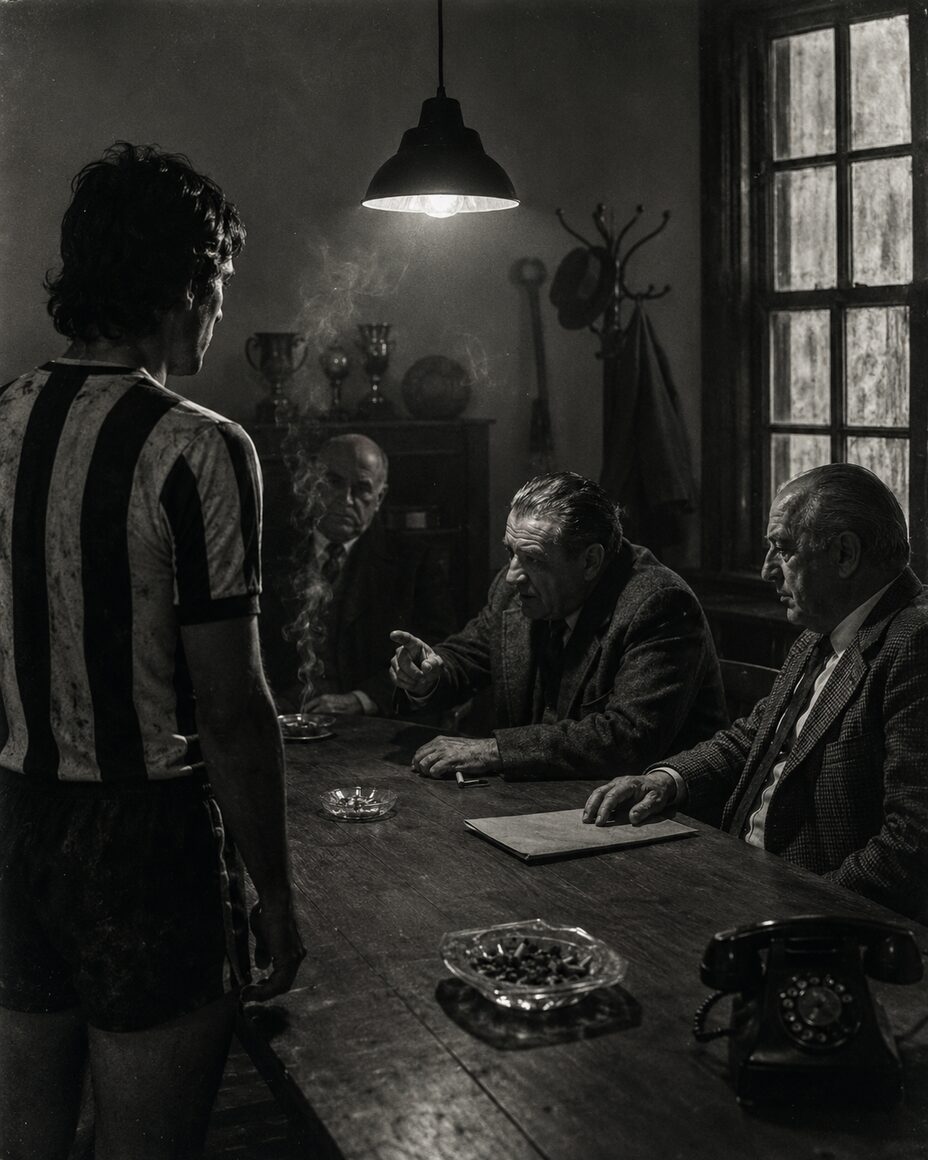
Funes was called to the club offices at 21:30 on Friday, 14 November. The match was scheduled for Sunday afternoon. Present in the room were club president Aurelio Santoro, treasurer Héctor Saldívar, football secretary Néstor Alvear, manager Rubén Garay — and goalkeeper Daniel Cordero.
Funes immediately understood that this was not an ordinary tactical meeting. There was no assistant coach. No team sheet. No medical report. On the table was a bottle of whisky, five glasses, and a folded sheet of paper containing three handwritten lines.
Ferroviaria ahead at half-time.
Final difference: one goal.
No dismissals.
Santoro argued that promotion would destroy Bellafría financially. He said the club needed another year. He said nobody would remember a single defeat once the debts had been paid. Funes asked why the goalkeeper was already in the room. Nobody answered. Then he asked whether the other players knew. Garay looked down at the table. Saldívar poured another drink. Cordero did not speak.
Funes stood. Santoro told him to consider what would happen to the club if he refused.
“You are not asking me to save the club. You are asking me to let you keep it.”The sentence appears in no official record. Three people later remembered hearing versions of it.
06 — The Dressing RoomWhatever they told you
On Sunday, Bellafría's dressing room was unusually quiet. The players could hear supporters singing outside two hours before kickoff. Nobody mentioned promotion. Nobody mentioned the meeting. Funes watched the goalkeeper lace and relace the same boot. Two senior defenders avoided eye contact.
Manager Rubén Garay read the lineup without discussing tactics. Before leaving the room, he gave a single instruction: “Do not lose your heads.” Funes stood in front of the door. He did not give a speech. He looked at each player and said:
“Whatever they told you, you still have to live here tomorrow.”
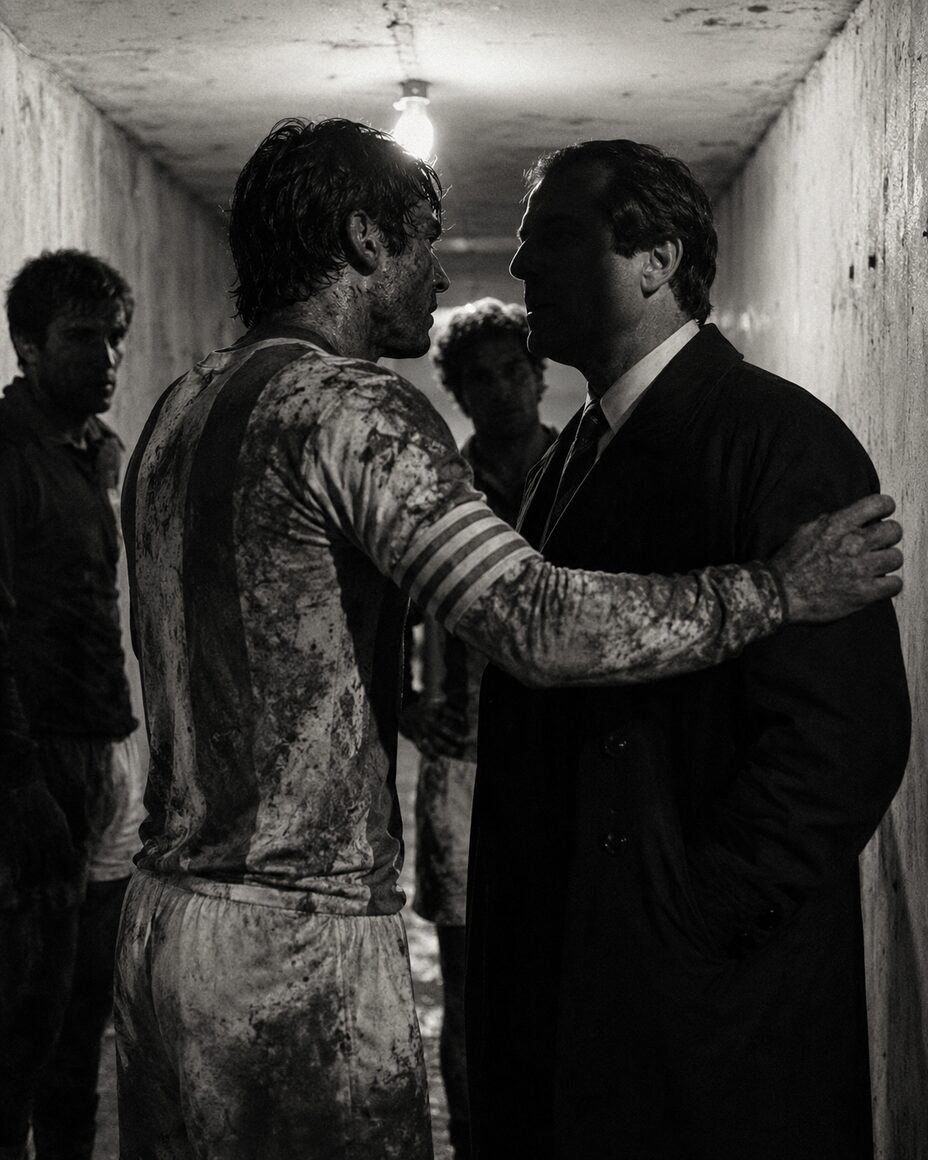
The team entered the tunnel. The noise outside was so loud that no one could answer.
07 — The MatchThe first line completed
Bellafría began too cautiously. Its midfielders stopped pressing. The fullbacks remained deep. Ferroviaria controlled possession without creating clear chances. In the 31st minute, a cross entered Bellafría's six-yard box. Goalkeeper Daniel Cordero took one step forward. Then he stopped. The ball passed less than a metre from his hands. Ferroviaria's forward headed into an empty corner. Cordero fell after the ball had crossed the line.
The stadium went silent before the visiting section began celebrating. Funes walked toward the goalkeeper. Cordero did not look at him. The captain said nothing and returned to the centre circle. At half-time, Ferroviaria led 1–0. The first line of the instruction had been completed.
The dressing-room door closed. Nobody sat down. Manager Garay told the team to remain compact and avoid unnecessary risks. Funes asked whether Bellafría intended to attack. Garay replied: “We intend to finish the match with eleven players.”
Treasurer Héctor Saldívar entered the room without knocking. Board members did not normally enter at half-time. He stood beside the door and reminded the players that contracts for the following season had not yet been renewed. The meaning was clear. A young midfielder began crying quietly.
Funes removed the captain's armband and placed it on the treatment table. For several seconds, no one moved. Then he picked it up again. He tightened it around his arm. And he walked back toward the tunnel.
The arrangement required eleven men to protect it. It began collapsing when four decided they would rather play.
08 — The 88th MinuteHe jumped
In the second half, Funes abandoned the position he had played for fifteen years. He moved into midfield. Then further forward. Bellafría's manager shouted at him to return. He ignored him. At first the other players did not follow. Funes chased clearances, pressed defenders, won free kicks, argued for every throw-in. The crowd recognised what was happening before the dressing room did. Every time the captain crossed halfway, the noise increased.
Then one midfielder joined him. Then another. Bellafría's right winger began attacking again. In the 71st minute, Funes headed narrowly wide. In the 79th, Ferroviaria's goalkeeper saved his shot from outside the area.
In the 88th minute, Bellafría won a corner. Garay ordered Funes to remain near the halfway line. The captain entered the penalty area. The first cross was cleared. The second ball reached the right wing. Funes stood between two defenders, mud across his shirt, blood beneath his nose from an earlier collision. The next cross arrived too high for the forwards. It was falling behind them. Funes moved backwards. He jumped.
The header struck the underside of the crossbar. For a moment the ball disappeared above the goalkeeper. Then it dropped behind the line.
Bellafría 1. Ferroviaria 1.
The stadium entered the pitch before the referee could restart the match. Supporters lifted Funes above the perimeter fence. The captain's shirt was torn from his body. A photographer captured him from behind, one arm raised, while police and supporters fought beneath him. The official match report records the goal. It does not record what happened inside the directors' box.
09 — The Tunnel & The MorningYou have no idea what you have done
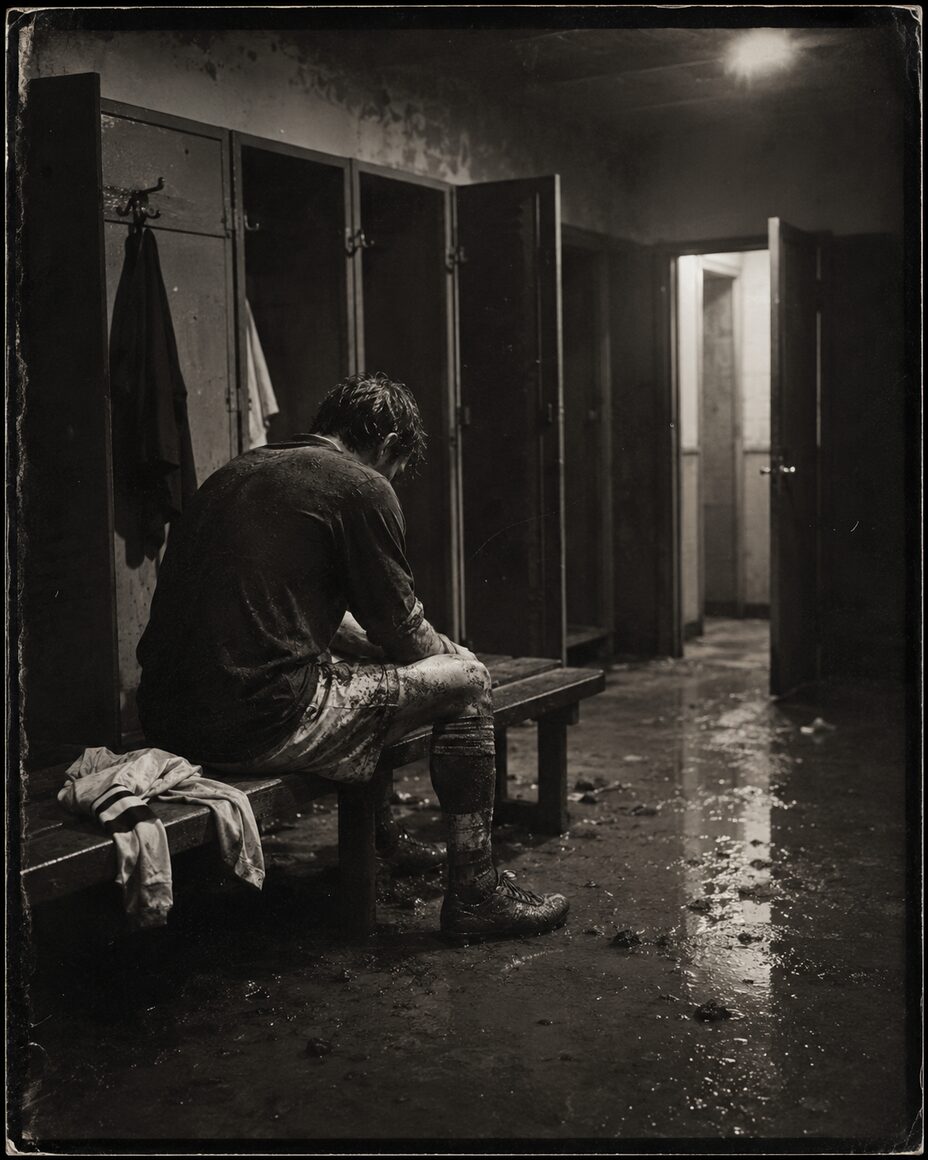
Bellafría's players returned to the dressing room through a side entrance. Funes arrived last. Aurelio Santoro was waiting in the tunnel. Witnesses disagreed about what happened next. One player said the president struck Funes. Another said Funes pushed him against the wall. A third remembered only shouting. All agreed on one sentence. Santoro told the captain: “You have no idea what you have done.”
“I know exactly what I didn't do.”
At 10:00 the following morning, Bellafría issued a short statement. Leandro Funes had been suspended indefinitely for “conduct incompatible with institutional discipline.” The statement did not mention the match. It did not mention the goal. It did not mention the boardroom meeting. His locker was emptied before he arrived at training. The club retained his registration but refused to select him — which prevented him from immediately joining another team.
Promotion did not save Bellafría. The club entered the national division with inadequate facilities and significant debt. Its accounts were audited for the first time. The review identified payments to two suppliers connected to board members, and discovered that the private loan attributed to Germán Valcázar had never been formally approved by the membership. Santoro resigned eight months later, citing health problems. Saldívar left the country. Goalkeeper Cordero conceded nineteen goals in eleven matches and retired at twenty-nine. Funes returned to the railway workshops. Bellafría were relegated two seasons later.
10 — The Missing MinutesThe ledger that skips a fortnight
The minutes from the board meeting of 14 November 1969 do not appear in the surviving club ledger. The pages have not been torn out. They were never numbered. The entries move directly from 7 November to 21 November. No formal meeting is recorded during the intervening period.
NOVRECORDED
NOVRECORDED
No meeting recorded · 8–20 November 1969The instruction seen on the boardroom table was never recovered. A former secretary later claimed he burned it — “better for everyone.”
In 1988, a former club secretary claimed he had burned the handwritten instruction after being told it was “better for everyone.” He refused to identify who gave the order. He died before providing a formal statement.
11 — The Captain's ArmbandThey just didn't have the match
Leandro Funes kept only one object from that afternoon. The captain's armband. It remained inside a kitchen drawer for thirty-six years. In 2005, a local radio presenter asked him whether he had been ordered to lose. Funes did not confirm the meeting. He did not deny it. He placed the armband on the studio table and said:
“They already had the result. They just didn't have the match.”It was his only recorded public statement about that afternoon.
He died in 2013. Bellafría lowered its flag to half-mast. The club obituary called him “a symbol of loyalty and promotion.” It did not mention his suspension.