Kaiser FC/ Football Culture/ Archive 005
Archive 005
Identity & Memory
5 min read

The Last
Great
Curvas

Long before kickoff, before the teams emerge and before the first chant rolls across the stadium, the curva is already awake.

Modern football often treats the crowd as part of the spectacle. The camera cuts toward it between moments of action. Television directors search for reactions after goals. Broadcasters use it as visual evidence of atmosphere. The supporters become another element within the production.

The great curvas developed according to a completely different logic.

They never saw themselves as spectators.

They saw themselves as participants.

This distinction may appear subtle from a distance, yet it changes everything.

Because once a tribune begins viewing itself as part of the match rather than an audience watching it, a remarkable transformation occurs. The crowd develops rituals. Rituals become traditions. Traditions become identity. Over time, the section behind the goal acquires something that is surprisingly difficult to define but immediately recognisable to anyone who has experienced it.

A personality.

The great curvas of Southern Europe and the Balkans were never merely architectural spaces. Concrete alone cannot explain their influence. Thousands of stadiums contain concrete steps. Very few become cultural institutions.

The Unwritten Rules.

The things that were never written down because they were never intended to be forgotten.

Article I The new member inherits. He does not create. Everything here existed before he arrived.
Article II The banner belongs to no one. It belongs to all of them, including those who never held it.
Article III The song must be earned, not explained. If you need to ask what it means, you will understand in time.
Article IV You do not leave before the final whistle. Not when winning. Not when losing. Especially not when losing.
Article V The section remembers. Every generation owes it the same obligation.

What transformed these places was repetition.

Year after year.

Generation after generation.

The same songs.

The same meeting points.

The same banners.

The same unwritten rules.

People came and went. Players arrived and departed. Coaches changed. Owners changed. Entire eras of football disappeared.

The curva remained.

Eventually it became possible to think about the section behind the goal almost as one thinks about a neighbourhood. Newcomers entered an existing culture rather than creating one from scratch. Customs already existed. Expectations already existed. Stories were already circulating long before the latest generation arrived.

A teenager attending for the first time was not joining a crowd.
He was entering a tradition.

The curva remembers. It remembers victories that younger supporters never witnessed. It remembers old stadiums that no longer exist. It remembers rivalries, journeys, friendships and moments that gradually become part of local mythology. The stories survive because people continue telling them.

In this sense, a curva functions less like a seating area and more like a living archive.

Southern Europe — The Keepers

Every generation inherits
material created by those
who stood there before.

The banners. The songs. The stories. None of it was designed. All of it was accumulated. Passed from hand to hand, season to season, without ceremony or instruction.

The keepers of the banners

Italy produced some of the most influential examples of this phenomenon. Cities with strong local identities naturally developed football cultures that reflected them. Naples, Genoa, Palermo, Turin and countless others each produced distinctive ways of occupying the same architectural space. The chants differed. The aesthetics differed. The symbols differed. Yet the underlying principle remained remarkably consistent.

The curva existed as a community.

Not a collection of individuals.

The Balkans pushed this idea even further. History, geography and politics combined to create football cultures where identity often carried unusual weight. Clubs became connected to neighbourhoods, cities and local histories in ways that outsiders sometimes struggled to understand. The result was a stadium culture capable of producing extraordinary visual expression. Banners became storytelling devices. Choreographies became acts of collective memory. Entire sections of stadiums developed visual languages recognisable without a single word being spoken.

What emerged was something larger than football.

A form of cultural expression.

This explains why the most memorable curvas often remain fascinating even when the match itself has faded from memory. Visitors sometimes leave unable to recall the score while remembering every detail of the atmosphere. The songs survive. The colours survive. The feeling survives.

The result becomes secondary.

The culture remains.

Yet the title of this archive raises an uncomfortable question.

Why speak of the last great curvas?

Because football continues changing. Modern stadium design values comfort, visibility and commercial efficiency. These goals are understandable. In many cases they have improved the experience significantly. Stadiums are safer. Infrastructure is better. Access is easier.

Yet every improvement introduces trade-offs.

The conditions that produced the great curvas emerged slowly across decades. They relied upon continuity. Familiarity. Local identity. Affordable access. Generations occupying the same spaces long enough to develop traditions capable of surviving their creators.

Such environments are difficult to manufacture intentionally.

They must grow. And growth requires time.

This is why surviving curvas remain so important. They preserve something increasingly rare within modern football. They remind us that atmosphere cannot simply be purchased. Identity cannot simply be designed. Culture cannot simply be installed during construction.

It must be lived.
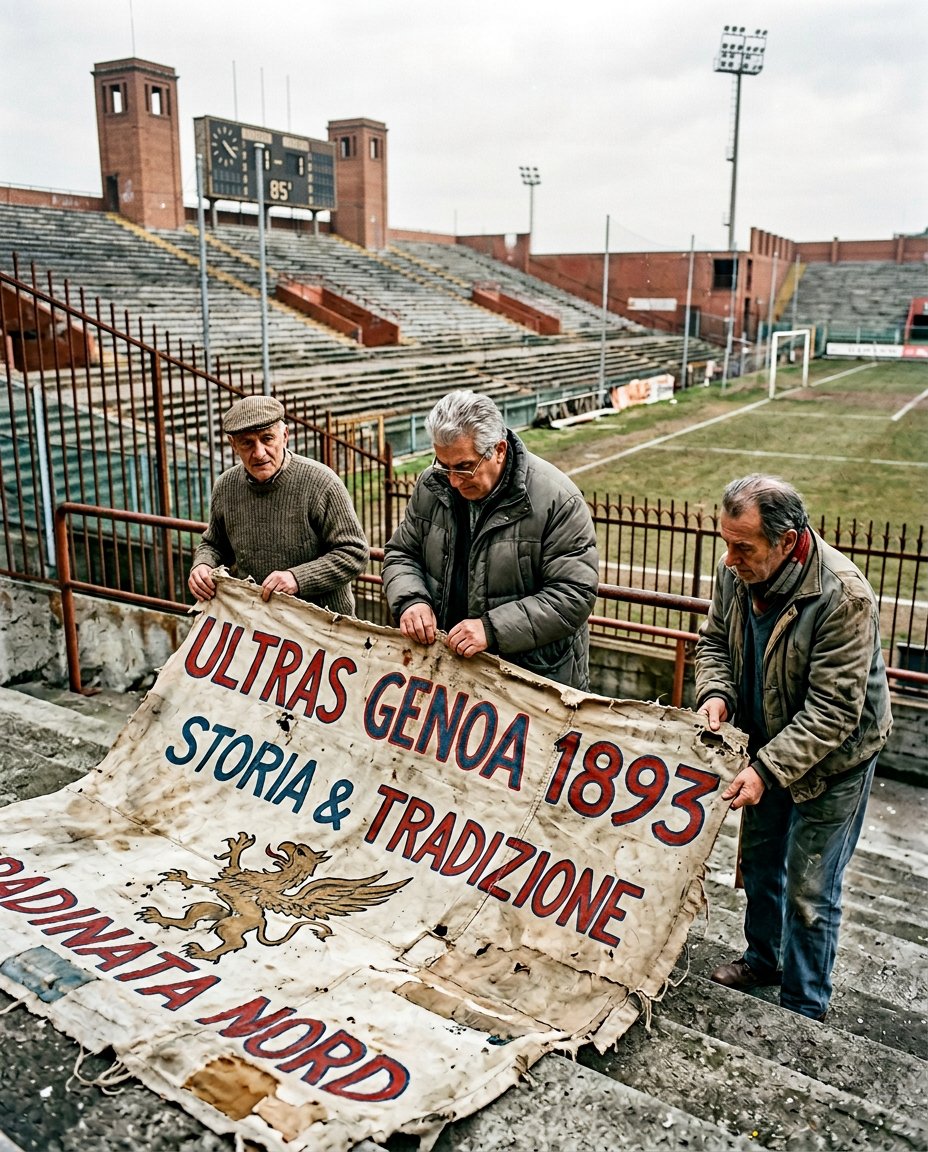
The First Time He was entering a tradition — not a crowd

The great curvas endure because they represent one of football’s oldest truths.

A memory.

A tradition.

A community.

A living thing.

The most important part
of a stadium has never
been the concrete.

It has always been
the people returning to it.

Again.
And again.
And again.

Continue The Archive
Archive 006The Archive — Final5 min read

The Same Game, A Thousand Different Worlds

Football never truly became global.It became local thousands of times.

Read Next Archive
Wear The Archive View The Collection