Kaiser FC/ Football Culture/ Archive 002
Archive 002
Community & Theatre
5 min read

The City That
Sings Before
Kickoff

In some places, football begins when the referee blows the whistle. In Naples, it begins long before anyone reaches the stadium.

There are football cities.

And then there is Naples.

The distinction becomes obvious almost immediately.

A visitor arriving on matchday morning expects to encounter the familiar signs of football anticipation. Scarves appearing in shop windows. Newspapers discussing team selections. Groups of supporters gathering in cafés before making their way toward the stadium.

Naples offers all of those things.

Then it offers something else.

Football seems to have escaped. It leaks out of the stadium and into the city itself, settling among apartment blocks, market stalls, church squares and narrow streets that were already alive long before the first ball was kicked.

The game does not feel confined to a venue.

It feels woven into the urban fabric.

To understand football in Naples, one must first understand the city. That is not a romantic observation. It is a practical necessity. The two have become so intertwined that separating them often produces misunderstandings.

Naples has never been easy to explain. It frustrates outsiders because it refuses simplicity. It is beautiful and chaotic, elegant and worn, proud and vulnerable, ancient and restless. The city possesses a personality so strong that visitors frequently spend their first days trying to understand it and the remainder of their lives failing.

Football arrived here like it arrived elsewhere.

The remarkable part is what happened next.

Many cities adopted football.
Naples absorbed it.

The game became another language through which the city could speak about itself. Cultures accumulate gradually, through repetition, memory and shared experience. Generations inherit rituals without remembering who created them. Traditions become so familiar that they begin feeling permanent.

By the late twentieth century, football had become inseparable from everyday life in many parts of the city. Not because matches occurred every day. Because football provided a common reference point capable of connecting people who otherwise shared very little.
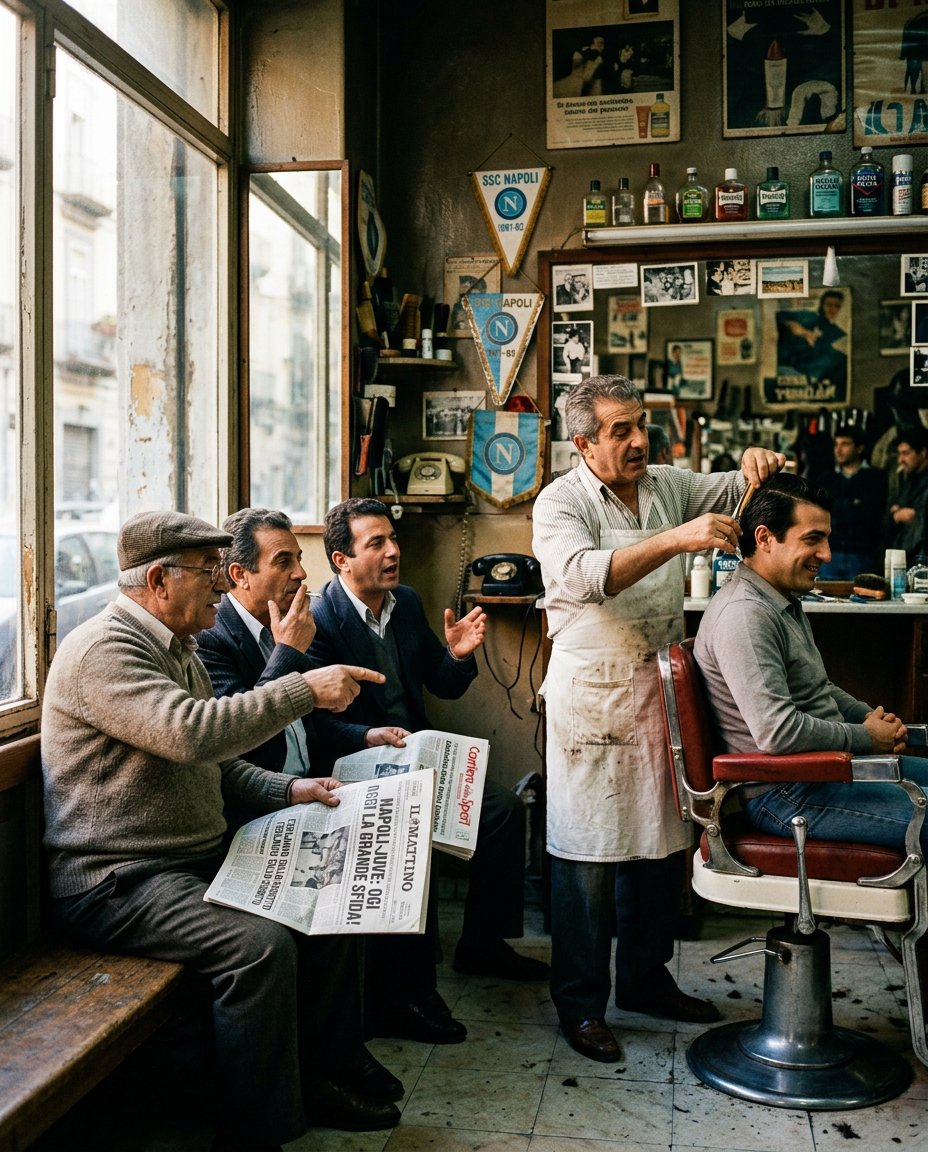
The City
Before Kickoff.

Six different lives. One shared afternoon.

I The Café Owner

Has been discussing the formation since before dawn. Offers a prediction with every coffee. Has not been wrong about the first goal in eleven years.

II The Fisherman

Speaks of the match the way he speaks of weather. As something already known. Something that arrives on its own terms, regardless of opinion.

III The Student

Knows the statistics better than the coach. Has brought four different arguments to the same table and left with five new ones.

IV The Taxi Driver

Has already assessed the referee. Delivered the same verdict three passengers ago. Will not be changing it.

V The Grandmother

Has watched from the same balcony for forty years. Rarely comments. When she does, conversation stops.

VI The Child

Kicks a ball against the wall and imagines the goal. Is already, in some essential sense, already there.

Each occupies a different world. Football creates temporary bridges between them.

This becomes visible long before kickoff. A visitor walking through Naples on matchday morning notices conversations unfolding across entire neighbourhoods. Football appears in fragments. A prediction shouted from one balcony to another. A debate emerging from an open doorway. A discussion continuing across café tables already occupied for hours.

The city seems to be rehearsing.

Not formally. Not consciously.

Yet something collective is taking shape.

This atmosphere explains why so many supporters describe Naples as a place that sings before kickoff. The phrase should not be understood literally — although singing certainly occurs. What matters is the feeling behind it.

The city participates.

Football is not waiting inside the stadium.

It is already happening.

Naples matchday morning

Southern Italy — Naples

Football is not
waiting inside
the stadium.
It is already happening.

The experience begins at breakfast. It begins when café owners arrange chairs outside their establishments. It begins when flags appear from balconies and children begin imagining the afternoon ahead.

Perhaps this is why football in Naples often feels closer to theatre than to entertainment. The match remains important, but the performance begins much earlier. Streets become stages. Conversations become scenes. Entire neighbourhoods contribute to a shared emotional narrative that slowly builds toward kickoff.

The stadium eventually becomes the focal point.

It is not the starting point.

In many modern football environments, the supporter arrives at the stadium to consume an event. The experience begins at the gate and ends at the final whistle.

Naples operates differently.
The experience begins at breakfast.

It begins when market vendors start discussing team news. It begins when flags appear from balconies and children begin imagining the afternoon ahead. By the time supporters approach the stadium, much of the emotional work has already been completed.

The city has prepared itself.

Napoli Southern Italy — The Game Is Already Happening

People often focus on the visible spectacle. The banners. The noise. The packed stands. Those elements matter, but they are merely the final chapter of a much longer story.

The real culture exists within the hours leading toward them.

Inside ordinary conversations. Inside familiar routines. Inside communities repeating customs inherited across generations.

Naples excels at preserving those customs because the city itself has always possessed a powerful relationship with memory. History remains visible here. Not behind museum glass, but in everyday life. Buildings carry stories. Streets carry stories. Families carry stories.

Football became part of that landscape.

Another layer added to an already complex identity.

This helps explain why the sport often feels unusually personal in Naples. Supporters are not merely defending a club. They are expressing attachment to a city that has spent centuries developing a strong sense of itself.

And perhaps that is why visitors leave with such vivid memories.

Not because of the score.

Not because of the result.

Not even because of the stadium.

What remains is the sensation of having witnessed an entire city moving gradually toward the same emotional destination.

A city discussing.
A city arguing.
A city preparing.

Long before anyone reaches their seat.
Long before the referee checks his watch.

The city was already singing.

Continue The Archive
Archive 003Distance & Loyalty7 min read

A Thousand Kilometres For Ninety Minutes

There are easier ways to spend a weekend. This much becomes obvious the moment the journey begins.

Read Next Archive
Wear The Archive View The Collection