To them, a banner is fabric.
A scarf is cloth.
A faded flag hanging from a railing appears no different from any other piece of decoration carried to a sporting event. The misunderstanding is understandable.
The old supporters understood this instinctively. They knew that trophies and banners occupied very different places within football culture.
A trophy celebrates what happened.
A banner remembers who was there.
The distinction may appear small at first, but it explains why certain flags survive long after the victories they once witnessed have faded from memory.
Few supporters can recite every result from fifty years ago. Few remember the exact sequence of league tables, cup runs and promotions that shaped a club’s history. Time quietly erodes statistics. Even the greatest victories eventually become fragments.
Yet many supporters can immediately recall a particular banner.
They remember where it hung.
They remember who carried it.
They remember the away trips where it appeared unexpectedly above distant terraces and railway stations. They remember photographs in which it occupied the same corner of the frame year after year, becoming so familiar that nobody imagined it could ever disappear.
The banner became part of the club’s visual language.
Part of its identity.
Part of its memory.

Archive 003 · Flags · Memory
This is why football supporters sometimes react so strongly when a banner is lost, damaged or stolen. Outsiders see an object. Supporters see accumulated years.
The cloth itself is irrelevant.
The meaning attached to it is not.
Many of the most respected banners were never beautiful. Some were painted hastily. Others faded under years of rain and sunlight. Lettering cracked. Colours softened. Repairs became visible. Every imperfection added another chapter to the story.
A pristine replacement could always be produced.
What could never be replaced was history.
That is what old banners carried.
History.
Evidence that people had travelled, sung, waited, suffered and returned.
Evidence that loyalty had occupied physical space.
Perhaps that is why football culture has always treated certain flags with extraordinary care. They are transported carefully. Stored carefully. Protected carefully. Sometimes hidden entirely from public view when not in use.
Not because they are valuable in monetary terms.
Because they contain something rarer.
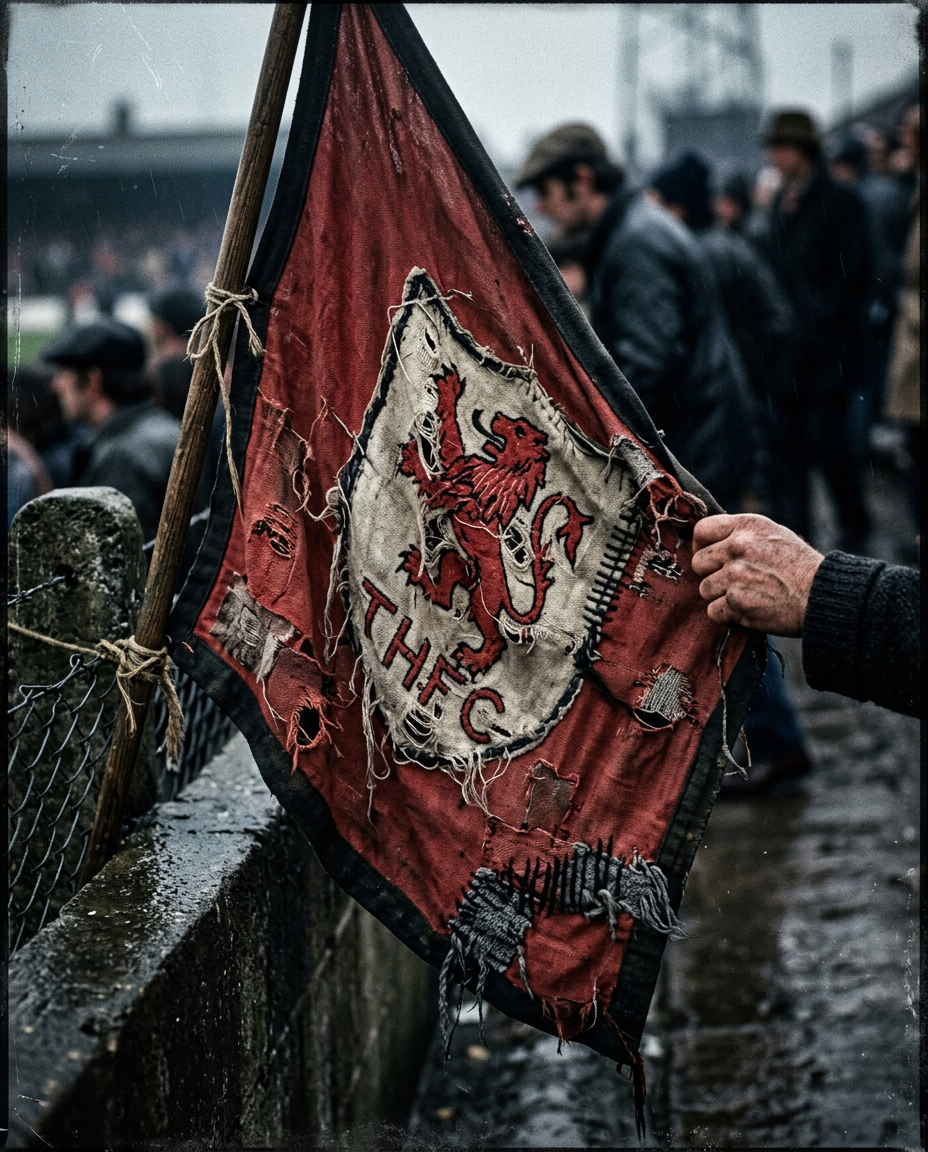
Archive 003 · Flags · Devotion
Memory.
A trophy can be won again.
A banner can never live
the same life twice.
The old supporters understood this long before anybody thought to explain it. That is why some flags still matter decades after the matches have ended.
And why, in certain corners
of football culture,
they always will.