Every football banner spends far more time hidden than visible.
The terrace tells only a small part of the story.
For a few hours each week, a banner hangs proudly above the crowd. It catches the wind, appears in photographs and reminds everyone that a particular group of people has arrived. Supporters point toward it. Visitors notice it. Cameras capture it. For a brief moment, the banner becomes public.
Then the match ends.
The crowd disappears.
The stadium empties.
And the banner returns to the shadows.
This part of football culture is rarely discussed, perhaps because it feels too ordinary to mention. Yet every historic banner survives because somebody, somewhere, has spent years protecting it between matches.
The old supporters understood this responsibility instinctively. A banner left exposed to weather would fade. A banner stored carelessly would rot. A banner forgotten would eventually disappear. Preservation required effort.
Not dramatic effort.
Quiet effort.
The kind of effort that rarely appears in photographs.
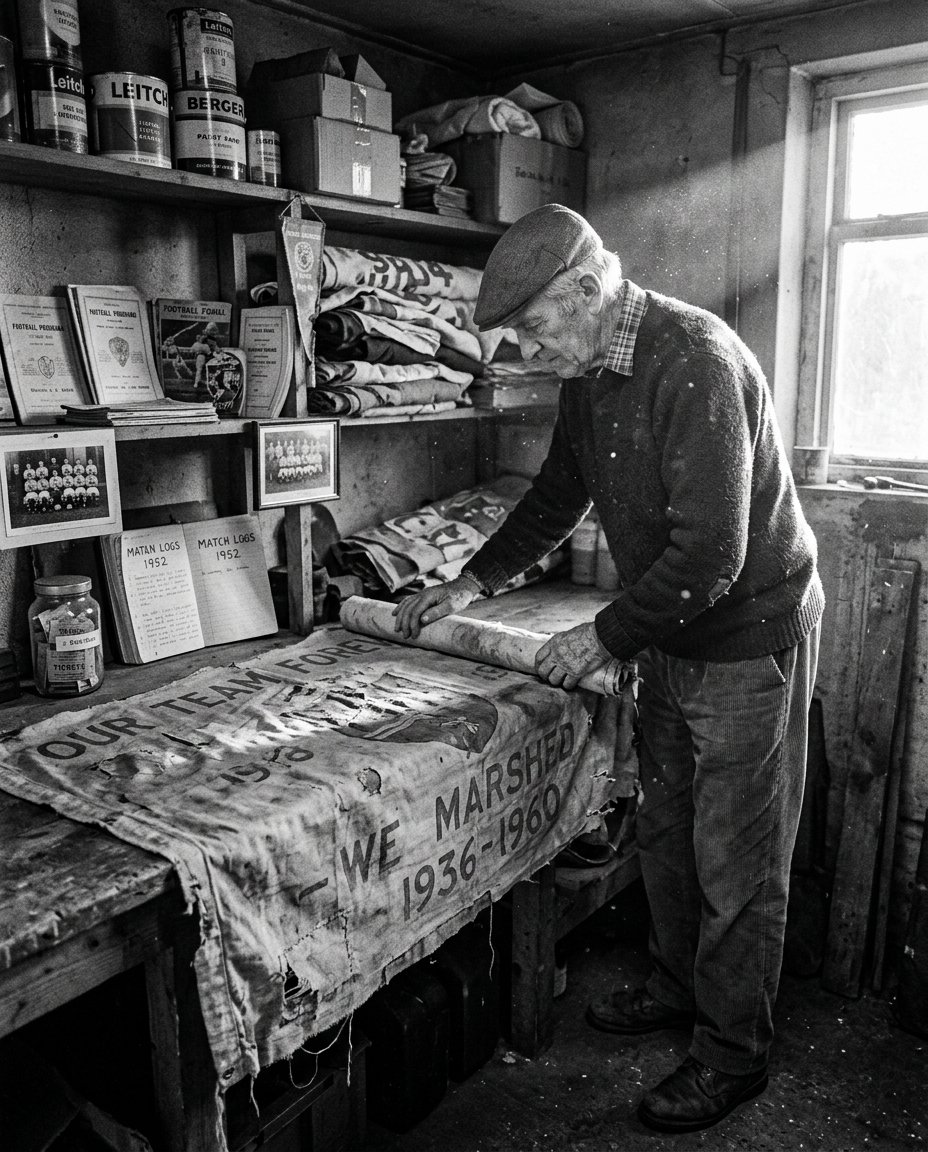
Archive 006 · Flags · Guardians
Across football history, countless banners have spent their lives resting inside garages, workshops, social clubs, spare rooms and hidden storage spaces known only to a handful of trusted people. These locations were rarely impressive. Most were practical. Concrete floors. Wooden shelves. Metal hooks. Dust. Paint. Tools.
What made them important was not the building itself.
It was what the building contained.
Rolled carefully against a wall might be a banner that had travelled for thirty years. Folded neatly on a shelf might be another that had witnessed promotions, relegations and generations of supporters growing old together. Each carried a history invisible to anyone passing outside.
In many ways, these rooms functioned as unofficial museums.
Not museums built by governments.
Not museums visited by tourists.
Museums built by ordinary supporters who understood that memory requires guardians.
The objects stored there were rarely valuable in monetary terms. Their value came from association.
Every stain had a story.
Every repair recorded an accident.
Every faded section reflected years spent
exposed to rain, sunlight and movement.
The banner aged because it lived.
That distinction mattered.
Modern culture often celebrates what is new. Football culture has always reserved special affection for things that endure. An old banner carries proof of survival. It has remained present despite changing generations, changing stadiums and changing times.
That continuity creates trust.
Perhaps that is why older supporters often speak about banner storage locations with unusual discretion. Not secrecy for its own sake, but protection. Certain places become part of the culture’s infrastructure. They are not important because they are hidden. They are hidden because they are important.
The terrace is where the banner is seen.
The storage room is where the banner survives.
One creates visibility.
The other creates longevity.

Archive 006 · Flags · Rest
Both are necessary.
And somewhere tonight, long after the floodlights have gone dark and the supporters have returned home, thousands of football banners around the world are resting quietly inside forgotten rooms.
Waiting for the next journey.
Waiting for the next match.
Waiting for the moment
they are needed again.