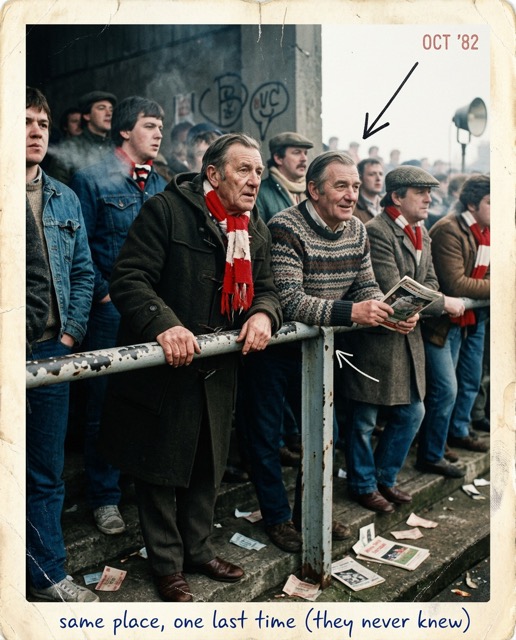
It may be nothing that official history cares about. A cold Saturday. A grey sky. A weak first half. A bad pitch. A queue outside the same gate. Two men walking the same route they had walked for years, carrying the same impatience, the same opinions, the same small rituals worn smooth by repetition.
One says they should have left the pub earlier.
The other says there was no point rushing.
One complains about the team selection before seeing the team properly.
The other says he has been complaining about team selection since 1976.
They laugh, or they do not. It does not matter. The conversation belongs to them because it has belonged to them for decades. It is not new, not sharp, not remarkable. It is part of the furniture of friendship.
That is how the last match begins.
Not with significance.
With habit.
Football friendship is often built in repeated places. The same train, the same pub, the same gate, the same step, the same rail, the same walk back after the match. Years pass through these rituals quietly. Men grow older inside them without quite noticing. Hair changes. Coats change. Knees become less forgiving. Children appear, grow, stop coming, return with children of their own. Managers arrive and fail. Players become memories. Stands are repaired, renamed, demolished or made too clean. But the friendship survives by returning to the same pattern.
Then one day the pattern breaks.
Not always dramatically. Not always at once. Sometimes illness interrupts. Sometimes age does. Sometimes distance, work, money, family, pride, silence or a tiredness no one names clearly. Sometimes one man dies before anyone has had the good manners to understand that the last match was already behind them.
The living are left to identify it later.
That is the strange labour of memory. It goes backward through ordinary days and marks one of them as sacred after the fact.
It becomes important not because it announced itself, but because nothing came after it.
The seat beside him was filled again by someone else. The terrace shifted. The route to the ground remained. The club kept playing. The fixture list continued with brutal efficiency. Football is merciless that way. It does not stop because one private world has ended. There is always another kickoff. Another programme. Another argument. Another coach under pressure. Another striker who cannot finish. Another Saturday arriving as if it has no idea what has been lost.
At first, the absence may feel temporary.
He could not come this week. He will be back next time. He has missed matches before. Everyone misses matches. Life has a way of interfering with football and then giving it back. So the friend waits. Saves the place perhaps. Looks toward the entrance. Checks the time. Makes the old complaint alone. Tells someone nearby that he will be here for the next one.
Then the next one comes.
And he is not there.
The body learns absence before the mind accepts it. The friend turns to speak and finds no one in the correct place. A goal goes in and the celebration lands badly because the shoulder that should have been grabbed is missing. A terrible refereeing decision produces the perfect insult, but there is no one beside him who would understand why it is perfect. The walk out becomes shorter and longer at the same time.
Shorter because there is less conversation.
Longer because silence takes up space.
People often speak about football as if the club is the great constant. The shirt. The badge. The ground. The colours. The songs. But for many supporters, the real constant was a person. Someone who stood beside them so often that the match became partly shaped around his presence. He was not additional to the day. He was part of the day’s structure. Remove him, and the same ground becomes slightly wrong.
That is what Brotherhood means here.
Not grand speeches. Not public loyalty. Not a marketing word printed across a campaign.
A man who knew where you stood.
A man who knew when you had lost faith before you admitted it.
A man who could make the same joke for twenty years and somehow keep it alive.
A man who could tell from the way you walked into the pub whether the week had been bad.
A man who did not ask sentimental questions because standing beside you was the question and the answer.
The last match together is unbearable because it makes ordinary things glow too late.
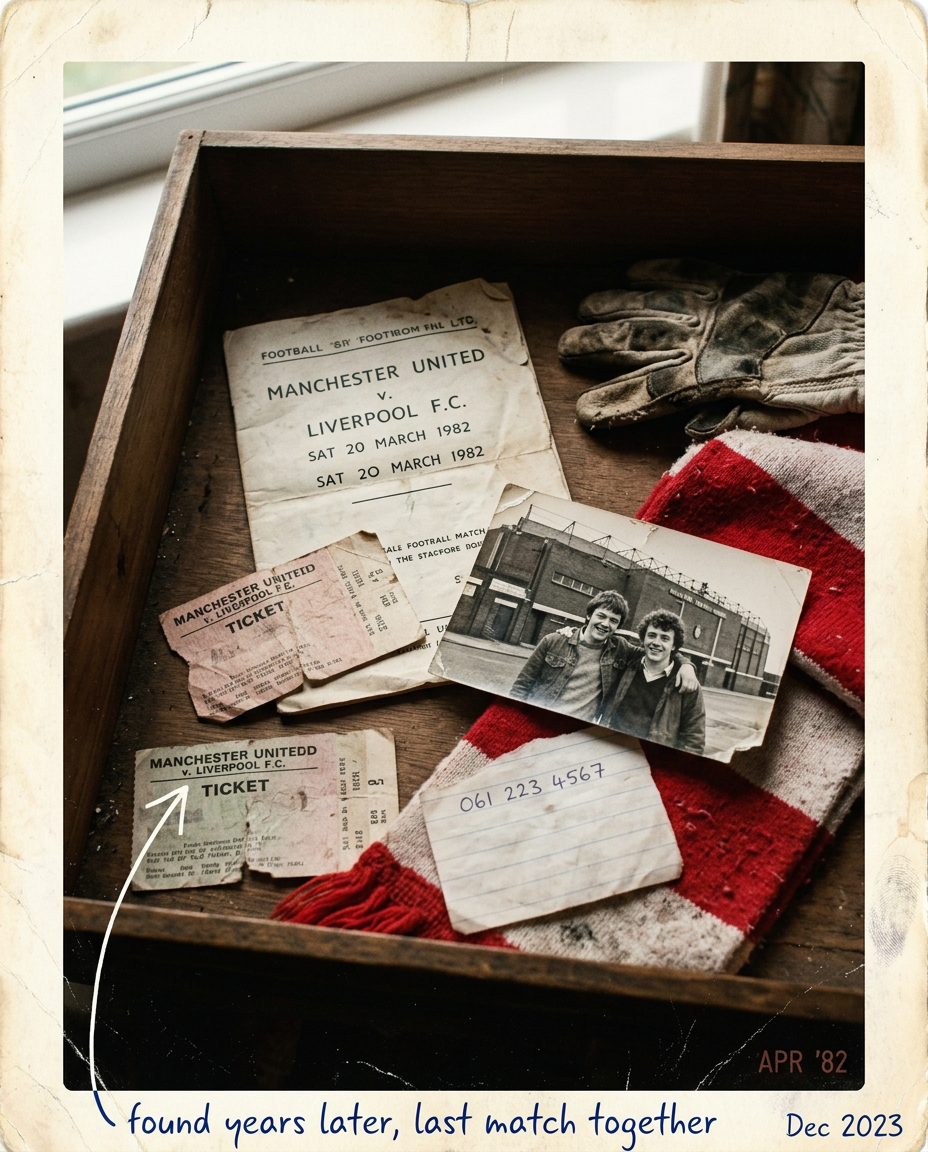
The ticket stub, if it survived, becomes evidence.