Kaiser FC/ Brotherhood/ Archive 014
Archive 014
Distance & Voice
8 min read

The Call After
The Final Whistle

Some friends do not need to be beside you to share the match. They wait at home, in another town, after work, beside a radio or a silent telephone. And when the final whistle goes, there is only one person you need to call before the result becomes just a result.

There are football matches that cannot be left inside the stadium.

The final whistle goes, the crowd exhales, the players begin walking toward the tunnel, and the result settles into the air with a kind of authority nothing can resist. The game is finished. The scoreboard is no longer a threat or a possibility. It has become fact. Supporters turn toward the exits, search for friends, fold programmes, light cigarettes, button coats, check watches, and begin the long movement back into ordinary life.

But for some, there is one thing that must happen before the day can continue.

They have to make the call.

Not because the person on the other end does not know the score. He may know it already. He may have heard it on the radio, seen it on television, followed it through updates, been told by someone at work, or watched the result appear somewhere without any of the weather attached to it. But knowing the score is not the same as knowing the match.

That is why the call matters.

A result can travel alone.
A match needs a witness.

The friend on the other end may not have been able to go.

The Absent Friend

Work kept him away. Family kept him away.
Illness, distance, money, age, exile.

Football friendships do not always end
when people stop standing beside each other.

Sometimes they continue through the phone. There are people whose place in football is partly made of absence.

An absent friend receiving the match from home by phone

Work kept him away. Family kept him away. Illness, distance, money, age, obligation, exile, a move to another town, a shift that could not be swapped, a child who needed collecting, a life that had become too complicated for Saturday to remain sacred. Football friendships do not always end when people stop standing beside each other. Sometimes they continue through the phone.

In the old days, this meant finding a payphone outside the ground, inside a pub, in a station, on a street corner where the receiver was cold and the queue behind you had no patience for emotional analysis. It meant coins in the pocket, the smell of rain on wool, noise spilling out of doors, supporters passing behind you still arguing about the same chance. It meant cupping one hand around the receiver and trying to explain ninety minutes before the world interrupted.

“You should have seen it.”

That was often the first real sentence.

Not “we won,” though that mattered. Not “we lost,” though that weighed heavily. Not even “you won’t believe it,” though football has produced millions of calls built exactly on that phrase. The deepest impulse was simpler: you should have been there.

That is the sentence hidden inside every call after the final whistle.

It is an accusation and an embrace at the same time. It says the match was incomplete without you. It says I noticed your absence. It says something happened and I cannot carry it properly until I have given some of it to you.

Some friendships are made of shared presence. Others are made of shared reporting. The friend who receives the call becomes the stand-in for the absent terrace, the missing seat, the road not taken, the pint not shared, the argument postponed until later. He asks questions not because he lacks information, but because he wants the texture.

From The Other End The Questions Only A Witness Can Answer
“How bad was he really?”
“Was it a penalty?”
“Did the crowd turn?”
“How did we look after halftime?”
“Who started the song?”
“Were they better than us?”
“Did it feel like a win?”
He needed more than the number — he needed the temperature of the ground

That last question is important because football has always produced results that do not explain themselves. A draw can feel like robbery or rescue. A narrow defeat can feel like proof of life. A win can feel lucky, undeserved, enormous, fragile, inevitable or strangely hollow. The person who was not there needs more than the number. He needs the emotional temperature of the ground. The call provides it.

The caller becomes a messenger from the place itself. He carries the sound, the weather, the mood, the injustice, the relief, the laughter, the dread. He describes the goal too loudly. He exaggerates the tackle. He imitates the old man behind him. He repeats what someone shouted at the referee. He gets details wrong because adrenaline edits memory before truth can intervene. None of this weakens the call. It makes it human.

Football has never been transmitted only by official media. Long before highlights were available instantly and every angle could be slowed down, clipped, reposted and argued over, football travelled through voices. From ground to home. From pub to kitchen. From father to son. From one friend to another. The call after the final whistle belongs to that older transmission system. It is not polished, not neutral, not always accurate, but often truer than the report printed the next morning.

Because it tells you what the match did to someone.

There were friends who built entire seasons through calls like this. One went to the ground. One waited elsewhere. After each match, the same ritual returned. If the result was good, the call came quickly, almost breathlessly, while the crowd was still audible behind him. If the result was bad, it might come later, after the walk had cooled the anger or deepened it. Sometimes the phone rang and no one spoke for a second because both already understood.

Defeat changes the shape of a call.

After a win, words run ahead of themselves. The caller interrupts his own sentences. He starts in the middle. He gives the goal three different beginnings. He says, “Listen,” several times without making anything clearer. The friend on the other end laughs because the confusion is part of the pleasure. Joy rarely reports efficiently.

After defeat, the call can become heavy. The caller describes less and judges more. Or he describes everything with terrible precision, as if naming each failure might reduce its power. The friend listens, occasionally offers an insult against a player, a manager, a referee, a system, an entire club philosophy. These insults are not solutions. They are support. They say: I am here in the wreckage with you, even from a distance.

That is one of the quiet gifts of football friendship. It gives men a reason to call when they might otherwise remain silent.

Many friendships survive not because people discuss life directly, but because they keep discussing football until life appears around the edges. A match becomes the permitted subject, the safe door, the excuse. They begin with the goal and end up talking about work, health, money, children, age, loneliness, plans, old stories, next week. Or they do not. Sometimes football remains the whole conversation. That can be enough too. Not every form of care needs to announce itself as care.

A man can ask, “Did you see the game?” and mean, “Are you still there?”

Another can answer, “We were terrible,” and mean, “I needed to hear your voice.”

The call after the final whistle creates a bridge between the stadium and the absent friend. It extends matchday beyond attendance and proves that belonging is not limited to bodies inside the ground. There are people whose place in football is partly made of absence. The uncle who moved away but still waits for the phone. The friend on night shift. The father too old to climb the steps now. The brother in another country. The man who used to stand beside you and now follows the team through your voice because your voice is the closest thing he has to being there.

Those calls can become more important with time.
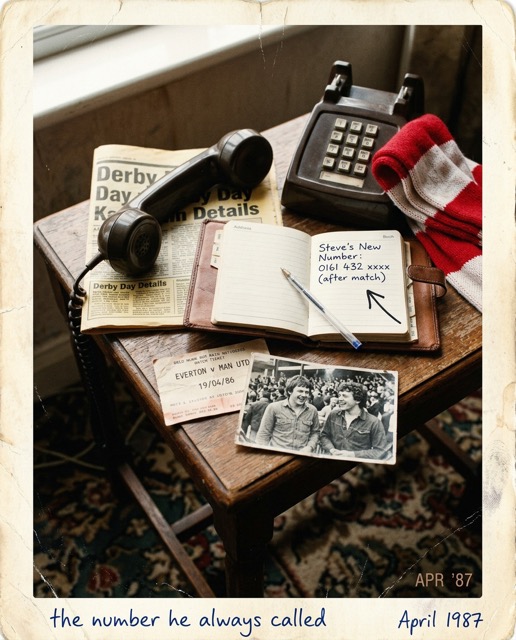
An old phone number, photographs and scarves kept in memory

At First Practical, Then Archive

A phone number remembered by hand.
A certain pub payphone.
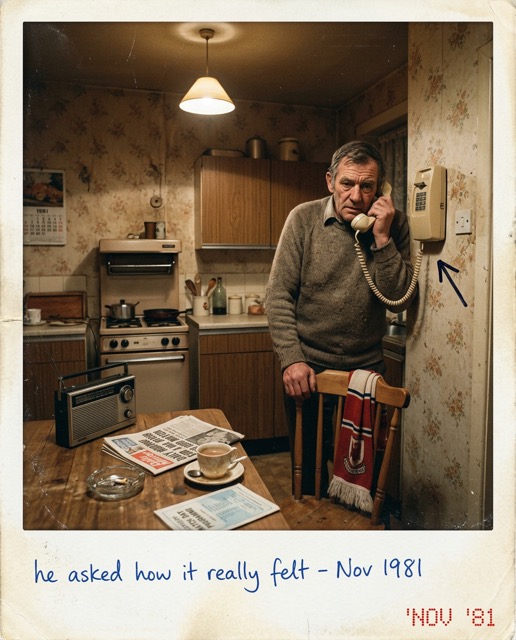
A kitchen wall phone with a stretched cord.

The pause before someone answers. The phrase always used after a bad loss. The same complaint made for twenty years. The way one voice aged before the other admitted noticing.

At first, they are practical. Later, they are habit. Eventually, they become archive. A phone number remembered by hand. A certain pub payphone. A kitchen wall phone with a stretched cord. The sound of coins dropping. The pause before someone answers. The phrase always used after a bad loss. The laugh after a ridiculous win. The same complaint made for twenty years.

Football records appearances, goals, transfers, managers, tables, trophies. It does not record who called whom after the final whistle. It does not record the men who kept each other connected to the game through description, irritation and loyalty. It does not record the friend who missed the match but still received it, piece by piece, through a voice still carrying the crowd behind it.

Kaiser FC does.

Because those calls are part of football culture. They are not secondary to the match. They are one of the ways the match becomes memory.

A goal seen by forty thousand people becomes different when one person calls another and says, “You should have been there.” Suddenly the moment is not only public. It becomes personal. It becomes addressed. It belongs to someone absent as well as to those who saw it. The call gathers the missing into the day.

That is what Brotherhood often does. It refuses to let absence become exclusion.

Even when time changes everything, the instinct remains. The payphone disappears. The landline becomes rare. The voice message replaces the immediate call. Highlights arrive before conversation. A result can be shared in a group chat with three words and a string of insults. But the deeper human need has not changed. Some matches still require one person in particular. Not the public, not the feed, not the comments, not the algorithm. One person.

The one who will understand why the second goal mattered more than the first.

The one who knows what that fixture used to mean.

The one who remembers the old stand.

The one who still laughs at the player neither of you rated.

The one you call before the match becomes content.

There is a sadness in this archive too, because one day some calls stop being possible. The number remains in an old book or a phone contact list, but the person no longer answers. The final whistle goes and the instinct rises before reality stops it. For a second, the body remembers the ritual better than the mind. Then comes the silence. No call to make. No one to explain it to in exactly that way.

That is when a match can feel strangely unfinished, even if everyone else has gone home.

The person was not only a friend. He was part of how football became complete.

Some supporters carry those unfinished calls for years. They still think, after a late winner or a dreadful collapse, of what they would have said first. They can still hear the answer. They know the old argument by heart. The phone no longer rings, but the conversation continues somewhere inside the matchday architecture of memory.

This is why the call after the final whistle belongs in Brotherhood.

Not because it is dramatic.

Because it is ordinary enough to be true.

A man leaves a ground. He finds a phone. He calls the person who should have been there. He says the score, then immediately begins correcting the score with feeling. He gives the match a second life through speech. On the other end, someone listens, interrupts, laughs, swears, asks the same question twice, disagrees with a match he did not see, and somehow becomes part of it anyway.

The final whistle ended the game.

The call made sure it reached the right person.

Share This Archive
Reddit X WhatsApp
Previous in the Archive
The Shirt He Borrowed
And Never Returned
Archive 013  ·  Objects & Memory  ·  8 min read