Kaiser FC/ Brotherhood/ Archive 013
Archive 013
Objects & Memory
8 min read

The Shirt He Borrowed
And Never Returned

Some football shirts are bought. Some are inherited. A few disappear into another man’s life and never come back, not because they were stolen, but because friendship quietly decided they belonged there.

Every football friendship has at least one object that never found its way back.

A scarf left in the wrong house after an away match.

A programme borrowed to check the lineup and folded into another pocket.

A lighter passed around on a cold terrace and never seen again.

A cassette, a photograph, a pair of gloves, a ticket stub, a badge, a jacket, a shirt.

Especially the shirt.

The shirt was never meant to disappear. That is important. It was not stolen. It was borrowed under circumstances that seemed too ordinary to remember at the time. Maybe rain came down harder than expected and one friend needed something dry. Maybe a five-a-side match needed one more player in the right colour. Maybe the away trip stretched into a night no one had planned properly. Maybe someone’s own shirt was forgotten, ruined, lost, too small, too wet, too covered in beer, too associated with a defeat nobody wanted to carry home.

So one man said, “Take this.”

And the other did.

That should have been the whole story. A shirt given for a day. A shirt returned the next week. A minor exchange between men who trusted one another enough not to make a record of it.

But football has a way of making ordinary objects disobey ordinary rules.

The borrowed shirt stayed away.

At first, nobody noticed. Or rather, one noticed and chose not to care. There would be time. They would see each other next match. The shirt would come back folded badly, probably unwashed or overwashed, smelling faintly of someone else’s house. There would be insults. There would be a small complaint about stretching the collar. The debt would be closed and forgotten.

Except it was not.

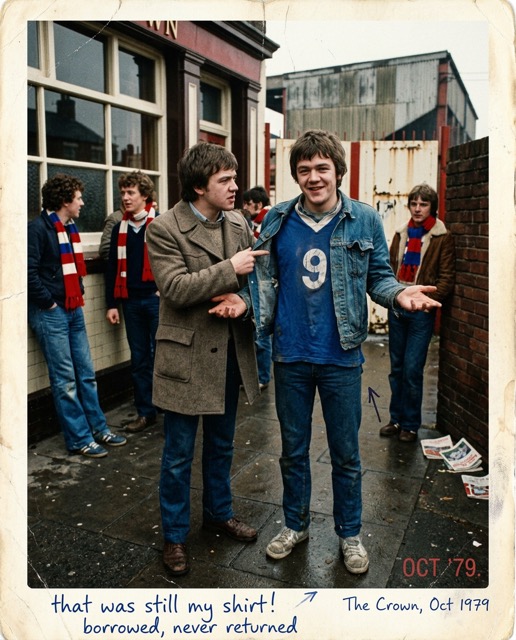
Weeks passed. Then months. The borrowed shirt became part of another routine. It was worn to training, to the pub, to watch matches on television, to sleep in after late nights, to paint a room, to stand on a terrace where it had not originally belonged. It collected the wrong life and somehow became more interesting for it. The owner would see it occasionally, across a room or under a jacket, and recognize it immediately.
The Long Joke

“That’s mine.”
“No it isn’t.”
“You gave it to me.”
“I’m keeping it until we win something.”

Everyone knew he would not give it back. Men who would never write emotional letters sometimes preserve each other through jokes like that.

A borrowed football shirt worn as part of another man's routine

“That’s mine.”

The reply was always predictable.

“No it isn’t.”

“You gave it to me.”

“I’m keeping it until we win something.”

“You’ll get it back.”

Everyone knew he would not.

This is one of the strange economies of football friendship. Objects move between people and change meaning as they move. A shirt bought in a shop is merchandise. A shirt worn through seasons becomes evidence. A shirt borrowed and never returned becomes a shared joke with a long memory attached to it. Its value is no longer only in the fabric, the badge, the number, the sponsor, the year or the design. Its value is in the story of why it is in the wrong wardrobe.

Men who would never write emotional letters sometimes preserve each other through jokes like that.

The shirt becomes a form of permission. Permission to belong inside another man’s history. Permission to take something and be trusted not to treat it lightly, even if every outward sign suggests exactly the opposite. It may be worn carelessly, washed incorrectly, left over chairs, stuffed into bags, dragged through rain, lent again to someone else without authorization. And still, beneath the abuse, there is a kind of care. The shirt survives because it has become too connected to the friendship to throw away.

This is why old football shirts are rarely just old football shirts.

They carry weather. They carry shape. They carry the body that wore them first and the body that kept them after. They remember periods of life more accurately than photographs sometimes do. A shirt can return someone to a year by touch alone. The roughness of the collar, the weight of cotton, the smell of damp after washing, the way the number cracked, the sleeve pulled slightly at the seam, the stain that never came out and became part of the garment’s authority.

A borrowed shirt contains two timelines.

The first belongs to the owner. The day he bought it. The match he first wore it to. The season it represented. The player he associated with it. The goals, defeats, pubs, trains, terraces, rooms and afternoons it had already absorbed before it left him.

The second belongs to the friend who kept it. The new places it went. The different photographs it appeared in. The ways it was worn without permission and then defended as if it had always been his. The arguments it started. The laughs it produced. The small irritation that became affection because it lasted too long to remain irritation.

Two Timelines One Shirt — Two Lives
The Owner
Bought new.
First worn that season.
Goals, trains, terraces.
Then it left him.
The One Who Kept It
New rooms, new photographs.
Worn without asking.
Defended as his own.
The joke that lasted years.

It stopped being property.

Somewhere between the two timelines — it became archive.

That word may sound too formal for something thrown over a chair or kept in a drawer with old socks, but football archives do not always live in museums. Most of them live badly. They live in cupboards, boxes, garages, attics, laundry baskets, coat hooks, bedside drawers and houses where nobody knows why a faded shirt is still there except the person who cannot let it go. Official archives preserve what institutions consider important. Private football archives preserve what life refused to return.

The borrowed shirt belongs to the private archive.

It says: we were close enough for ownership to become negotiable.

That matters because friendship in football is often built less from declarations than from shared inconvenience. You wait for someone. You save a place. You travel badly together. You stand in rain. You forgive lateness. You lend money, tickets, scarves, shirts. You argue about players. You insult each other with precision. You remember who was there when the match turned. You know which objects belonged to whom before the years blurred the paperwork.

This is Brotherhood without ceremony.

Not brotherhood as a slogan.

Not brotherhood printed large by people trying to sell emotion.

Brotherhood as a shirt that should have come back and did not.

There is humour in it, but there is also risk. To lend something meaningful is to accept that the other person may change it. He may damage it. He may not understand its importance. He may turn it into something else. But that is exactly what friendship does to memory. It does not preserve things perfectly. It alters them by sharing them.

A shirt returned too quickly remains only a loan.

A shirt kept for years becomes evidence of a bond.

Of course, sometimes the story changes with age. At twenty, the missing shirt is a complaint. At thirty-five, it is a running joke. At fifty, it is a photograph someone finds in a drawer and points at with sudden force. “That was mine.” By then, the accusation has softened. The shirt may be gone, or too damaged to wear, or still hanging somewhere absurd. The friendship may have survived, changed, faded or ended. But the object keeps a version of the men who once argued about it.

There is a sadness hidden in this too, because eventually there are shirts that cannot be returned even if someone wanted to.

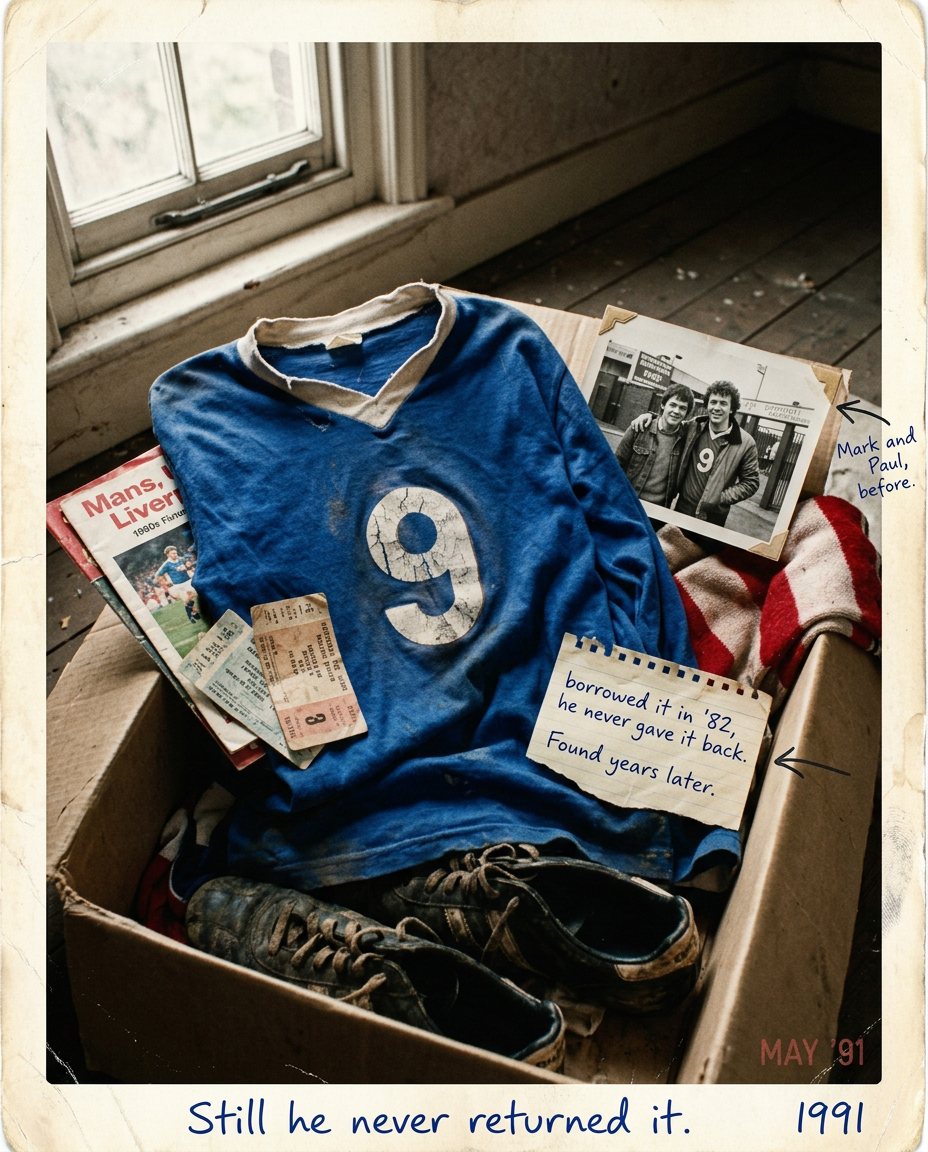
An old football shirt found years later in a drawer

What Life Refused To Return

A house is cleared. A drawer is opened.
Inside is a shirt that began as a loan
and became part of another life.

A man can dismiss grief in conversation, but he may still be unable to throw away a shirt. He can say it is only old fabric, then fold it more carefully than necessary.

A man dies. A house is cleared. A drawer is opened. Inside is a shirt that began as a loan and became part of another life. The original owner sees it again after decades, or perhaps never sees it again at all. Someone else holds it up and asks whether it should be kept, donated, thrown away, washed, framed. Practical questions arrive around an impractical thing.

What is the value of a shirt that now belongs to a friendship more than to either of them?

There is no clean answer.

Football is full of objects like that. Objects too personal to be valuable and too valuable to be treated as ordinary. They embarrass people because they make feeling physical. A man can dismiss grief in conversation, but he may still be unable to throw away a shirt. He can say it is only old fabric, then fold it more carefully than necessary.

The shirt he borrowed and never returned becomes, in the end, a record of proximity.

It remembers that someone once stood close enough to ask.

It remembers that someone else trusted him enough to give.

It remembers the joke.

It remembers the delay.

It remembers the argument that became tradition.

It remembers being seen in the wrong place and recognized anyway.

It remembers two lives crossing through cotton, colour, sweat and matchday weather.

The modern game produces endless shirts now. New releases, retro reissues, special editions, anniversary kits, sponsor variations, capsules, collaborations, drops. Football clothing has never been more abundant. But abundance can weaken attachment. When everything is available, less is irreplaceable. The borrowed shirt mattered because there was usually just one. That one. From that season. With that memory. Worn by that person. Taken by that friend. Kept too long.

Its scarcity was not manufactured.

It was lived.

That is the difference Kaiser FC cares about. Not shirts as products alone, but shirts as vessels. The ones that carried seasons, rooms, bodies, defeats, jokes, journeys and men who did not always know how to say what they meant to each other. A football shirt can be bought in seconds. It can take years to become true.

The one he borrowed and never returned was true because it crossed a boundary.

It left ownership and entered friendship.

And maybe that is why nobody ever really wanted it back.

Not completely.

Because as long as he had it, some part of the friendship remained visible. In photographs, in drawers, in arguments, in memory. The shirt was missing from one wardrobe, but present in the story both men carried.

That is not theft.

That is football.

Share This Archive
Reddit X WhatsApp
Previous in the Archive
The One Who
Saved Your Place
Archive 012  ·  Loyalty & Routine  ·  8 min read