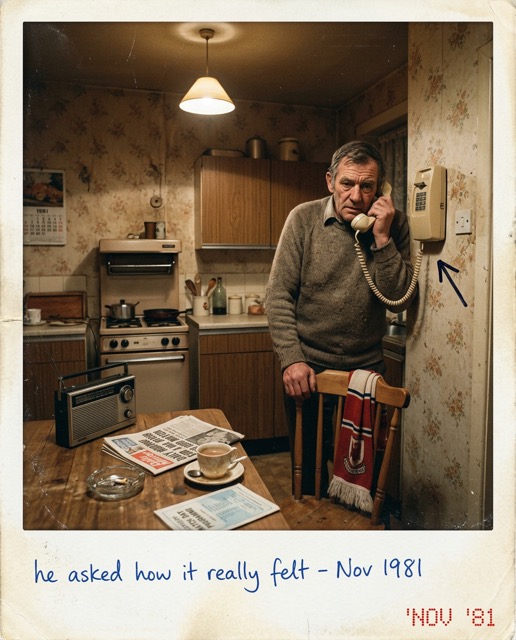
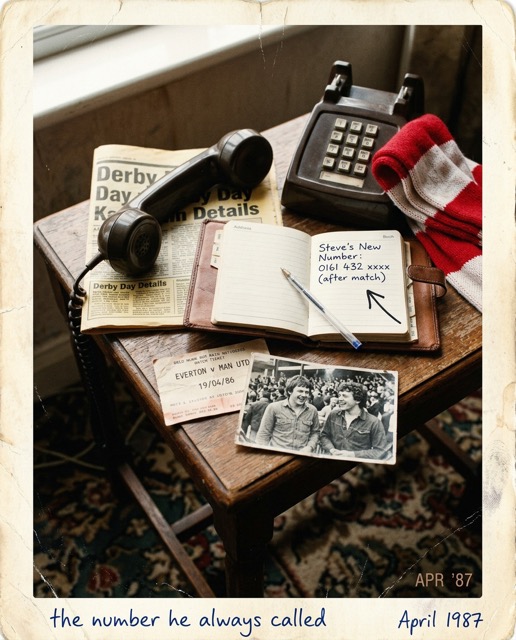
That last question is important because football has always produced results that do not explain themselves. A draw can feel like robbery or rescue. A narrow defeat can feel like proof of life. A win can feel lucky, undeserved, enormous, fragile, inevitable or strangely hollow. The person who was not there needs more than the number. He needs the emotional temperature of the ground. The call provides it.
The caller becomes a messenger from the place itself. He carries the sound, the weather, the mood, the injustice, the relief, the laughter, the dread. He describes the goal too loudly. He exaggerates the tackle. He imitates the old man behind him. He repeats what someone shouted at the referee. He gets details wrong because adrenaline edits memory before truth can intervene. None of this weakens the call. It makes it human.
Football has never been transmitted only by official media. Long before highlights were available instantly and every angle could be slowed down, clipped, reposted and argued over, football travelled through voices. From ground to home. From pub to kitchen. From father to son. From one friend to another. The call after the final whistle belongs to that older transmission system. It is not polished, not neutral, not always accurate, but often truer than the report printed the next morning.
Because it tells you what the match did to someone.
There were friends who built entire seasons through calls like this. One went to the ground. One waited elsewhere. After each match, the same ritual returned. If the result was good, the call came quickly, almost breathlessly, while the crowd was still audible behind him. If the result was bad, it might come later, after the walk had cooled the anger or deepened it. Sometimes the phone rang and no one spoke for a second because both already understood.
Defeat changes the shape of a call.
After a win, words run ahead of themselves. The caller interrupts his own sentences. He starts in the middle. He gives the goal three different beginnings. He says, “Listen,” several times without making anything clearer. The friend on the other end laughs because the confusion is part of the pleasure. Joy rarely reports efficiently.
After defeat, the call can become heavy. The caller describes less and judges more. Or he describes everything with terrible precision, as if naming each failure might reduce its power. The friend listens, occasionally offers an insult against a player, a manager, a referee, a system, an entire club philosophy. These insults are not solutions. They are support. They say: I am here in the wreckage with you, even from a distance.
That is one of the quiet gifts of football friendship. It gives men a reason to call when they might otherwise remain silent.
Many friendships survive not because people discuss life directly, but because they keep discussing football until life appears around the edges. A match becomes the permitted subject, the safe door, the excuse. They begin with the goal and end up talking about work, health, money, children, age, loneliness, plans, old stories, next week. Or they do not. Sometimes football remains the whole conversation. That can be enough too. Not every form of care needs to announce itself as care.
A man can ask, “Did you see the game?” and mean, “Are you still there?”
Another can answer, “We were terrible,” and mean, “I needed to hear your voice.”
The call after the final whistle creates a bridge between the stadium and the absent friend. It extends matchday beyond attendance and proves that belonging is not limited to bodies inside the ground. There are people whose place in football is partly made of absence. The uncle who moved away but still waits for the phone. The friend on night shift. The father too old to climb the steps now. The brother in another country. The man who used to stand beside you and now follows the team through your voice because your voice is the closest thing he has to being there.
Those calls can become more important with time.