Kaiser FC/ Matchday/ Archive 007
Archive 007
Belonging & Place
8 min read

The Seat You
Don’t Sit In

Some places in football are not owned, reserved or named. They become yours because you returned to them enough times. A step on a terrace, a wooden seat, a rail, a corner of the stand — the match was never only watched from there. It was carried there, week after week.

Every football ground has places that belong to nobody officially and to somebody completely.

A step halfway up the terrace. A wooden seat in the old stand. A place beside a barrier where the view is partly blocked but the feeling is right. A corner near the tunnel where the players can be heard before they are seen. A row under the leaking roof. A patch of concrete where a father once stood with his son, and where the son later stood without him.

To an architect, these are positions in a structure. To a club, they are capacity. To a ticketing system, they are numbers. To a supporter, they can become coordinates of memory.

The strange thing about a place in football is that it does not need to be comfortable to become yours. In fact, many of the places supporters remember most were uncomfortable in every practical sense. Too cold in winter. Too exposed in rain. Too low to see the far corner properly. Too close to the man who shouted too much. Too far from the exit. Too narrow, too hard, too familiar to be chosen by anyone thinking rationally.

But rational comfort was never the point.

People returned because the place had absorbed them. It knew their habits, or at least it felt that way. It knew where they put their programme, which pocket held the ticket, where their hand rested on the rail, which step their boot found without looking, which angle of the pitch first appeared when they climbed into position. The place had no memory of its own, but the supporter gave it one by returning.

That is one of the quietest rituals in football: the claiming of a place through repetition.

Not through money.

Not through legal ownership.

Not through a plaque.

Through showing up.

The Same Place Claimed Not By Ownership — By Return
You were temporary — the ritual was not

In old grounds, this mattered even more because the stadium was not designed around personal comfort. It was designed around presence. You entered, you climbed, you found your place and you became part of the arrangement. On terraces, the place was often not a seat at all, but everyone knew where they stood. Regulars found one another without arranging it. The same faces appeared in the same rough area with the reliability of weather. People knew who would complain early, who would defend the goalkeeper no matter what, who would leave five minutes before the end, who would bring his grandson twice a season, who had stopped coming and was missed without anyone making a speech about it.

That kind of belonging is difficult to explain to people who only understand attendance as consumption.

A supporter did not simply buy access to a match. He returned to a location within a shared life. The ground held his week in a way the rest of the city did not. It took the scattered parts of him — work, family, worry, age, memory, anger, hope — and placed them in the same square of concrete or wood every Saturday. From there, he could measure not only the team, but himself.

There were places in old stands where generations overlapped without ceremony.

Generations Overlap

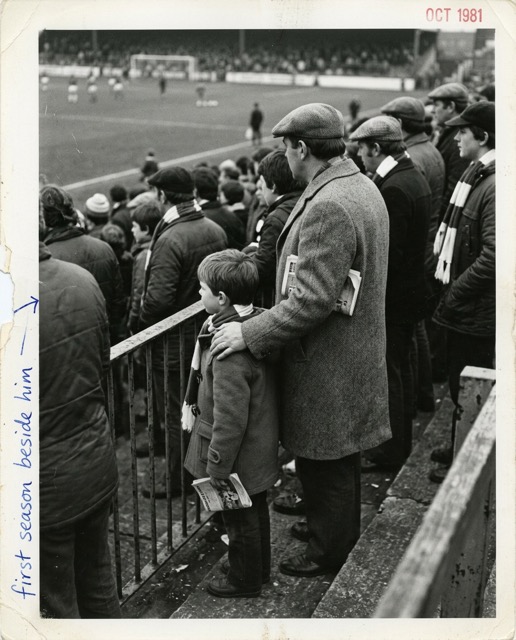
A father stood slightly behind his son
so the boy could see.

Years later, the son stood
in almost the same position — older now,
pretending not to look at the empty space beside him.

Football does this with cruelty and tenderness at the same time. It keeps the place long enough for absence to become visible.

A father and son sharing the same place in the stand

A seat can be empty in many ways.

There is the empty seat of someone late from the pub. The empty seat of someone ill for a week. The empty seat of someone priced out, moved away, banned by work, lost interest, lost health, lost time. And then there is the empty seat nobody discusses much because everyone understands. The place that remains physically available but emotionally occupied. A scarf may cover it for a moment. A hand may touch the back of it before kickoff. The match continues, because football always does, but the geometry has changed.

This is why the phrase “my seat” is often too small for what supporters mean. It is not only a view. It is a history of views. It is the place from which they first saw floodlights against winter sky, first saw a goalkeeper make an impossible save, first learned that anger could travel through a stand like electricity, first understood that grown men could sing without irony, first watched a team collapse, first watched a team rise, first felt the body next to theirs disappear from the routine.

The seat you don’t sit in is not defined by posture. It is defined by return.

Even in seated grounds, supporters often stand at decisive moments because the body refuses to let importance remain seated. A chance builds and the row rises before thought has time to negotiate. A corner is won, and people who have sat through forty minutes of cautious football are suddenly upright, leaning forward, hands gripping the seat in front. A late attack begins, and the whole stand forgets that chairs exist.

The seat may belong to the stadium.
Standing belongs to the nervous system.

That is why the old personal place survives inside new architecture. It may now have a number. It may be printed on a ticket. It may be selected online weeks in advance. But supporters continue to treat certain places as if they carry something more than allocation. They know the walk to them. They know the people nearby. They know how the light falls in August, how the cold arrives in November, how the pitch looks after rain, how the stand sounds when full, and how strange it feels when it is half-empty for a cup tie nobody claims to care about until the match begins.

The place teaches loyalty in a way slogans cannot. A club can tell supporters they are family. A marketing campaign can print belonging on walls and shirts and season-ticket brochures. But belonging is built less dramatically. It is built by returning to the same place enough times that the matchday begins to recognize your body. It is built when someone nods because they have seen you there before. It is built when your absence is noticed. It is built when your child is no longer small enough to stand in front of you and somehow that hurts more than expected.

In the past, this sense of place was more visible because stadiums wore memory badly and beautifully. Wooden seats cracked. Paint peeled. Numbers faded. Railings lost their shine under thousands of hands. Steps hollowed slightly where boots had stood for decades. The ground did not pretend to be new every season. It accumulated evidence. Each mark was part neglect, part archive.

Modern football often tries to remove visible age because age is bad for hospitality. It wants clean surfaces, readable signage, controlled movement, consistent lighting and seats that do not tell stories. There are reasons for some of this. Safety matters. Access matters. Cleanliness matters. But football loses something when every surface is reset into neutrality. The old grounds allowed supporters to feel that they were entering a place older than the product being sold that afternoon.

A worn seat told the truth. Others had been here before you. Others would come after you. You were temporary, but the ritual was not.

This is why so many supporters remember not only great matches, but ordinary ones from a particular place. A dull draw in rain. A freezing midweek cup replay. A meaningless end-of-season fixture. A match attended out of habit more than hope. These afternoons rarely enter club documentaries, but they form the real substance of support. Glory is too rare to carry a life by itself. It is the repeated return to the same place for ordinary matches that makes the great ones feel earned.

The seat you don’t sit in is where that ordinary loyalty becomes physical.

It is where you learn the pace of the ground. Where the first song sounds slightly different because of the roof above you. Where the man behind you mispronounces every new signing for three months. Where the child beside you grows taller between seasons. Where you discover that a football place can hold arguments, grief, jokes, boredom, superstition and hope without needing to name any of them.

And when the match ends, you leave it behind.
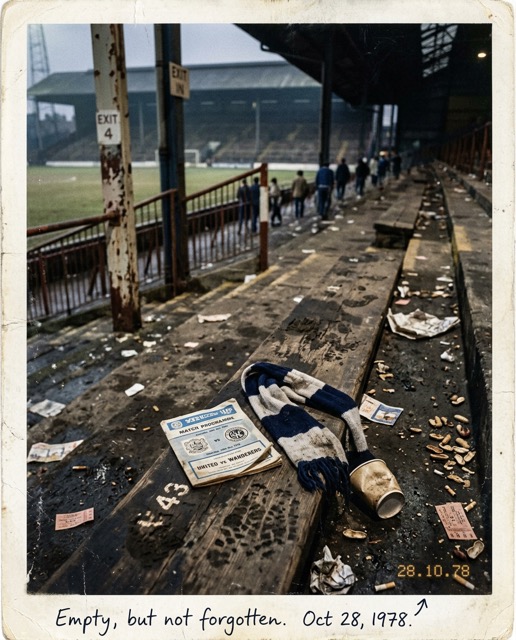
The empty place remaining in the stand after the match

It Remains Behind

The place feels yours,
but you do not take it with you.

It remains there in the darkening stand,
ordinary again.

Just a piece of stadium furniture or concrete — until the next time bodies arrive and memory returns to it.

That is the hardest part to explain. The place feels yours, but you do not take it with you. You stand, fold the programme, wait for the row to clear, look once more at the pitch, and walk away. It remains there in the darkening stand, ordinary again, just a piece of stadium furniture or concrete until the next time bodies arrive and memory returns to it.

Every matchday depends on these places. Not the official monuments, not the hospitality lounges, not the pitch-side cameras, not the places the broadcast chooses. The real map of football is made from thousands of private coordinates inside public grounds. A man’s barrier. A father’s row. A boy’s first step. A seat that was never really sat in because standing up was part of believing.

Football history records stadium names.

Supporters remember exactly where they stood.

Share This Archive
Reddit X WhatsApp
Previous in the Archive
The First Song
Changes The Air
Archive 006  ·  Atmosphere & Ritual  ·  8 min read