DOSSIER · MF–58/70 Brief Timeline Evidence Verdict
Historical Football Fiction
Dossier Boardroom Unresolved REF. MF–58/70 Italy · 1958–1970 8 min read

The Ninth
Contract

Nine clubs signed him. Almost none of them needed a striker.

FICTIONAL DOSSIER

The characters, clubs, documents and events in this dossier are fictional. The story draws on patterns of power, secrecy and opaque representation that have repeatedly appeared throughout football history. The cases are fictional. The patterns are not.

The 60-Second Brief

Between 1958 and 1970, an Italian centre-forward named Marco Franchi signed nine professional contracts. He made forty-seven senior appearances. He scored seven goals.

No surviving scouting report explains why nine clubs wanted him. No manager is known to have publicly requested his signing. No journalist ever interviewed him. Yet his career continued for twelve seasons.

Each agreement was registered during the same seven-day period in November. Each carried the countersignature of the same lawyer: Emilio Sanzio Baldini, working from a small office in Modena.

At three different clubs, former teammates later remembered an unidentified man in a grey wool overcoat waiting for Franchi after matches. When Franchi's federation file was catalogued, pages eight, nine and ten were absent — the only period in which the pattern might have been explained.

Nine contracts. Seven goals. One signature that never changed.

01 — The AllegationWhat the record cannot explain

Marco Franchi was not moving through Italian football because clubs needed his football. He was being moved because his registration, his contract or the transaction surrounding him served another purpose.

Perhaps he carried value that did not appear in his wages.

Perhaps his transfers connected presidents who could not be seen dealing directly with one another.

Perhaps he was a convenient name through which favours, obligations or money could pass.

Perhaps he knew exactly what he was doing. Perhaps he knew nothing.

The surviving record proves only that nine clubs signed him. It does not explain why.

02 — The First ContractSanremo, November 1958

The paperwork begins in Sanremo. On 8 November 1958, A.C. Portosole 1948 registered a twenty-year-old centre-forward from Chiavari named Marco Franchi. Nothing in the surviving club record suggests urgency.

Portosole already had four recognised forwards. Franchi had no significant senior experience. There is no preserved scouting report, recommendation letter or trial assessment attached to the agreement. The contract was prepared more than three hundred kilometres away in Modena by Studio Legale Baldini & Rovere.

At the bottom of the final page, beneath the signatures of the player and the club president, appeared the countersignature of the firm's senior partner:

E. S. Baldini

Franchi played six league matches. He scored once. Exactly one year later, during the same week in November, U.S. Riviera 1932 registered his second contract. The president changed. The club changed. The city changed.

The lawyer did not.
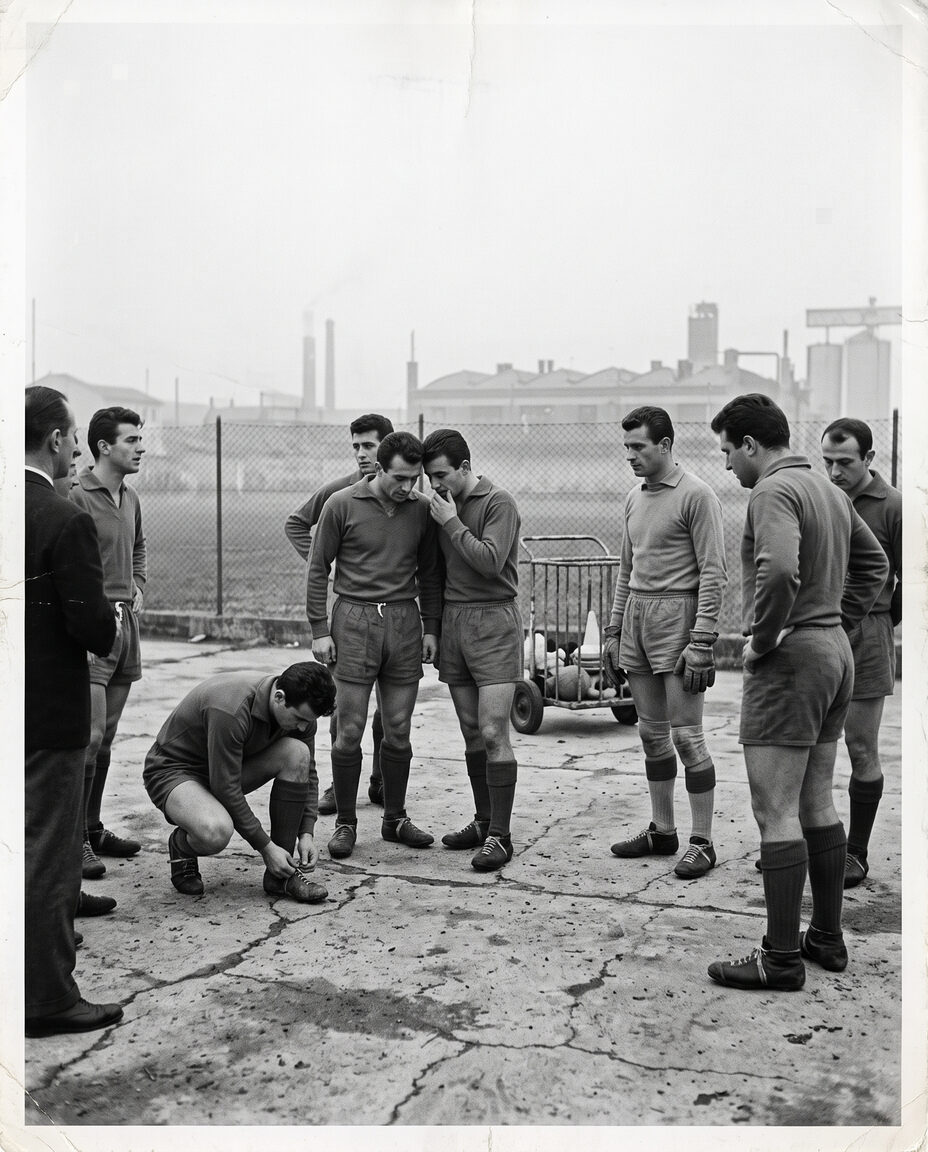
A footballer standing apart from his teammates on a training pitch in 1960s industrial Italy, unremarkable and unnoticed
The Player Nobody Needed Franchi, lost inside the squad KAISER FC RECONSTRUCTION

03 — The PatternThe safest place for a secret

By 1961, Franchi had signed four contracts in four years. Every agreement was deposited between 6 and 12 November. Every agreement had been prepared or reviewed by Baldini's office. The clubs had little else in common.

Some were fighting relegation. Others were pursuing promotion. One needed an experienced reserve. Another claimed to be investing in youth despite signing Franchi at twenty-five. His sporting value never became clear.

He was not fast enough to change matches.

He was not prolific enough to justify repeated transfers.

He was not famous enough to sell tickets.

He was not controversial enough to attract investigation.

That may have been his greatest value.

Marco Franchi occupied the safest place for a secret in professional football: the middle of the squad list. Stars attract cameras. Failures attract questions. Franchi attracted neither.

He trained. He appeared occasionally. He left. Then another contract arrived.
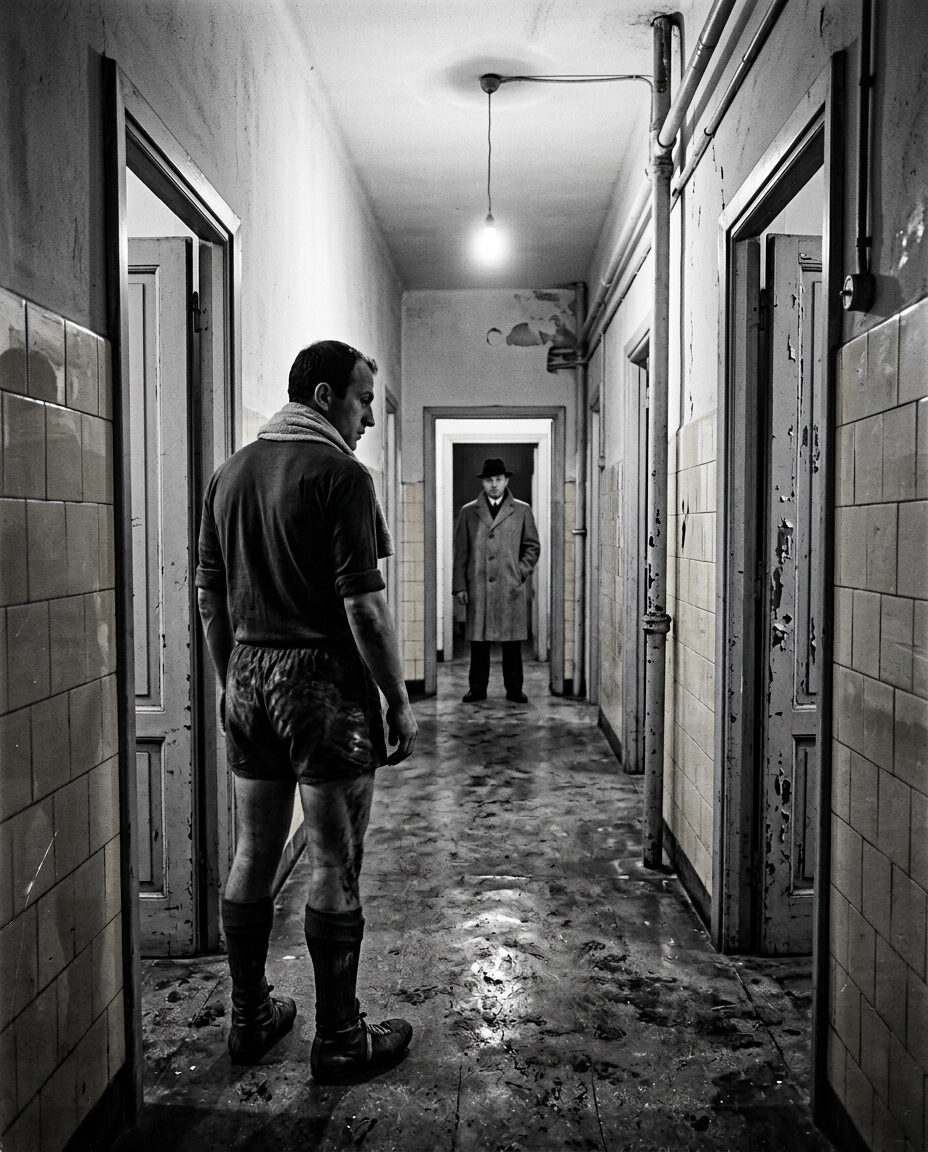
A player walking down a dim dressing-room corridor toward a motionless figure in a long grey overcoat and hat
The Man in the Grey Overcoat The presence that connects the contracts KAISER FC RECONSTRUCTION

04 — The Man in the Grey OvercoatThree dressing rooms, one figure

The first account appeared years later, in the testimony of a former Circolo Sportivo Valpadana defender. After a home defeat in November 1962, he remembered seeing a man waiting near the dressing-room corridor.

The man wore a grey wool overcoat.

He carried no notebook.

He wore no club scarf.

He did not appear to have watched the entire match.

When most of the players had left, Franchi stepped into the corridor. The conversation lasted less than two minutes. The man departed through the players' entrance. Franchi returned to the dressing room. No introduction was made.

Two similar accounts later emerged from different clubs. One placed the same figure outside A.S. Termini Bianchi's dressing room in Rome. Another remembered him beside the team bus during Franchi's period with U.S. Adriatica 1928. The descriptions were not identical. Memory rarely is. But all three accounts agreed on four details: the grey coat, the absence of club colours, the brief private conversation — and the fact that the man always appeared shortly before another contract was registered.

His identity never entered the official record.

05 — The Missing YearsPages that no longer exist

Franchi's surviving federal file contains fifteen pages. The pages are numbered consecutively from one to eighteen. Pages eight, nine and ten are absent. They were not renumbered. They were not replaced.

Fascicolo Federale · Franchi, M.
7PG. 07
PG. 08
PG. 09
PG. 10
11PG. 11

“Materiale non disponibile per consultazione.”Material unavailable for consultation. — FIGC archive annotation

The missing section covers the period between 1963 and 1965. Those were the years in which Franchi left Liguria, signed for A.S. Termini Bianchi on the outskirts of Rome and later moved to U.S. Adriatica 1928.

His appearances can be reconstructed from match reports. His contracts can be identified through club registers. What cannot be reconstructed is the reason for either move. The pages immediately before the missing section contain routine registration material. The pages immediately after it resume with another contract carrying Baldini's countersignature.

Nothing explains who removed them. Nothing establishes what they contained.
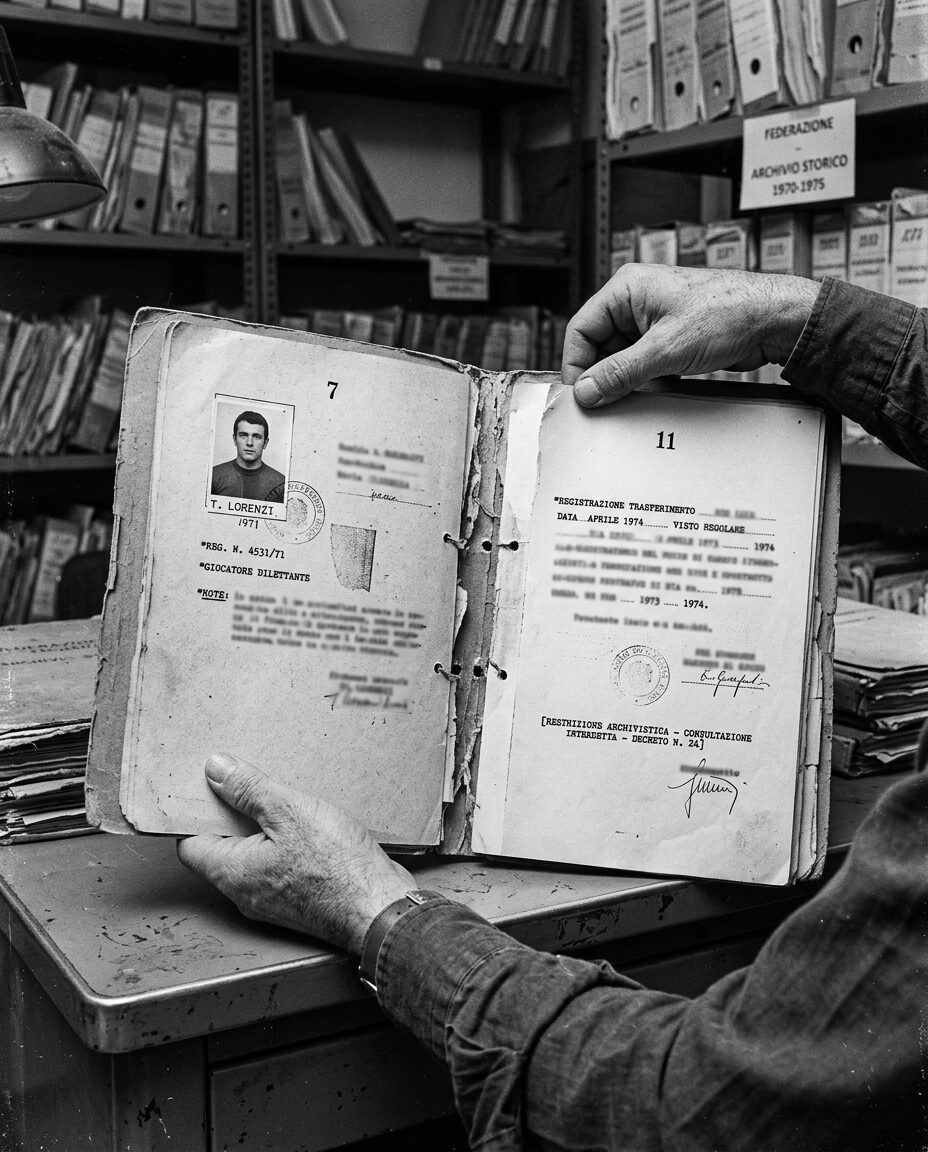
An archived federal file held open, the page numbering jumping from 7 to 11 where three pages are missing
Pages 8–10 The absence that keeps the case open KAISER FC RECONSTRUCTION

06 — The Ninth ContractCastelvetrano, November 1969

On 10 November 1969, S.S. Belice 1928 registered Marco Franchi as an experienced centre-forward. He was thirty-one. He had scored seven professional goals. The registration was prepared by Studio Legale Baldini & Rovere. It was Franchi's ninth contract and his eighth transfer.

By then, the pattern had existed for eleven years. Different clubs. Different presidents. Different regions. The same week in November. The same office in Modena. The same countersignature beneath every agreement.

Franchi made three appearances for Belice. He did not score. In June 1970, he retired without a testimonial, interview or public statement. He returned to Genoa and opened a small home-appliance shop on Via San Vincenzo. For the next forty-one years, he sold radios, washing machines and television sets.

No known journalist asked him about the nine contracts. No former president publicly explained them. Emilio Sanzio Baldini died in 1979. His legal practice closed within months. Marco Franchi died in 2011.

The three pages remained unavailable.

07 — Contract Timeline

Nine Signatures, Twelve Seasons

RegisteredClubLocationRecord
8 Nov 1958A.C. Portosole 1948SanremoBaldini countersigns
9 Nov 1959U.S. Riviera 1932BordigheraBaldini countersigns
7 Nov 1960Circolo Sportivo ValpadanaPiacenzaBaldini countersigns
11 Nov 1961F.C. Voltri 1936GenoaBaldini countersigns
6 Nov 1963A.S. Termini BianchiRomeBaldini countersigns
Federal pages 8–10 absent · 1963–1965 · record incomplete
12 Nov 1965U.S. Adriatica 1928AnconaBaldini countersigns
8 Nov 1967A.C. Piemonte MeridionaleCuneoBaldini countersigns
7 Nov 1968U.C. LomellinaMortaraBaldini countersigns
10 Nov 1969S.S. Belice 1928CastelvetranoBaldini countersigns

Nine contracts across twelve seasons. Eight transfers.
Every registration completed during the same seven-day period in November.

08 — Who Held the PowerThe names on the paperwork

Lawyer of record
Emilio Sanzio Baldini

The only named person present throughout Franchi's entire career. Represented no club officially and never appeared on a technical staff list. Nevertheless, his office prepared or countersigned all nine contracts. No surviving document explains why nine unrelated presidents relied on the same lawyer for the same player.

Different institutions, identical behaviour
The Nine Presidents

Each approved Franchi's registration. None left a recorded explanation for requesting him. None publicly questioned the next transfer. No surviving correspondence shows one president recommending Franchi to another. The chain continues without an observable beginning.

Identity unknown
The Man in the Grey Overcoat

Placed near three separate dressing rooms by later testimony. No club record lists a visitor matching his description. No photograph conclusively identifies him. Whether he represented Baldini, a president, an outside financial interest or only himself remains unresolved.

Player, participant or instrument
Marco Franchi

The central question is not whether Franchi moved. The contracts prove that he did. The question is whether he understood why.

Archive Status

The following classifications apply only within the fictional record of this dossier.

Proved
  • Marco Franchi registered nine professional contracts between 1958 and 1969.
  • He completed eight transfers and made forty-seven senior appearances.
  • He scored seven goals.
  • Every contract carried the countersignature of Emilio Sanzio Baldini.
  • Every registration was completed between 6 and 12 November.
  • Pages eight, nine and ten are absent from the surviving federal file.
Alleged
  • The man in the grey overcoat represented an interest shared by more than one club president.
  • Baldini's office handled obligations that were not recorded as part of Franchi's salary or transfer fee.
  • Franchi's registration was valuable independently of his performances.
Disputed
  • Whether Franchi knew why he was repeatedly transferred.
  • Whether the same unidentified intermediary appeared at all nine clubs.
  • Whether the missing pages were removed deliberately or lost during archival transfer.
Unresolved
  • Why nine clubs continued to sign a striker who rarely scored.
  • Why the same lawyer controlled the paperwork throughout the entire career.
  • What happened between 1963 and 1965.
  • What pages eight, nine and ten contained.
  • Whether Marco Franchi was the subject of the arrangement — or one of the people maintaining it.
10 — The Kaiser Verdict

The Least Important Part of the Transfer

Editorial interpretation. Not a legal finding.

Football remembers goals because goals are public.

Power prefers paperwork because paperwork is private.

Marco Franchi was never important enough to become famous. He was never disastrous enough to become a scandal. He spent twelve seasons in the narrow space between recognition and failure — visible enough to remain registered, forgettable enough to remain unexamined.

That may have been the point. A star would have attracted journalists. A major transfer would have attracted scrutiny. A prolific striker would have created expectations. Franchi created none. He was a name that could move quietly from one set of papers to another.

A player's archive usually records moments: a debut, a goal, a final, a photograph held above the head. Franchi's archive records transactions. Nine contracts. Eight transfers. One office. One lawyer. One week in November.

The question is no longer whether he was a good footballer. The question is why football was required at all. Perhaps the sport was simply the room in which the paperwork could exist. Perhaps the shirt made the movement legitimate. Perhaps the player was the least important part of the transfer.

The surviving record cannot prove what travelled between those nine boardrooms. It proves only that Marco Franchi travelled with it.

Football was built on men who arrived every Saturday to play. Marco Franchi arrived every November to be registered. That is the difference this dossier cannot close.

In-Universe Source Register

The following records are fictional components of the story world. They are not real archival holdings, interviews or publications.

Federal record

  • Fascicolo Federale: Franchi, Marco. Surviving pages 1–7 and 11–18. Missing pages 8–10.
  • Cover annotation: “Materiale non disponibile per consultazione”.

Contract records

  • Nine player agreements prepared or countersigned by Studio Legale Baldini & Rovere.
  • Registration dates spanning November 1958 to November 1969.

Contemporary reporting

  • Regional match reports documenting Franchi's forty-seven appearances.
  • Brief retirement notice published in Genoa, June 1970.
  • Emilio Sanzio Baldini obituary, November 1979.

Testimony

  • Three later accounts describing an unidentified man in a grey wool overcoat.
  • No account independently verifies his identity or function.
The Pattern Behind the Story

The names are invented. The pattern is not.

The Ninth Contract does not reproduce a single real scandal. It combines conditions that have appeared repeatedly around professional football:

Players represented by intermediaries whose influence exceeds their visibility.

Transfer decisions that make little sporting sense.

Presidents connected by lawyers, agents and private obligations.

Careers shaped by people who never enter the dressing room.

Records preserved by the same institutions whose conduct they might expose.

And footballers treated not only as athletes, but as registrations, financial instruments, favours, placeholders and leverage.

Marco Franchi did not exist. Neither did Baldini, the nine clubs or the man in the grey overcoat. But the central question remains recognisable:

How many players were moved because of what they could do on the pitch — and how many because of what their contracts allowed other men to do away from it? The names are invented. The pattern is not.

A Kaiser FC Fictional Dossier

Names, clubs, dates, documents and events in this story are fictional. This dossier uses historical football fiction to explore recurring patterns of power, money, loyalty and secrecy inside the game.

The cases are fictional. The patterns are not.

Open the case
Reddit X WhatsApp
The Dark Archive

Power, Fear, Money & Betrayal

Fictional dossiers set inside the hidden rooms of football history. Invented characters and clubs. Recognisable patterns.

MF–58/70Unresolved
Boardroom
The Ninth Contract
You are reading this
EV–66/ARDisputed
Boardroom
The Final Whistle Was Scheduled
Dossier in preparation
KM–78/DEProved
Terrace
Loyalty Was the First Weapon
Dossier in preparation
SV–72/YUUnresolved
Cover-Up
No One Could Prove He Existed Twice
Dossier in preparation
MK–55/PTAlleged
Dressing Room
He Had Fired Himself Eight Years Before
Dossier in preparation
The Human Archive

Why Football Matters

The Dark Archive explains what people have done because it mattered so much. The rest of the archive explains why it mattered at all — terraces, fathers and sons, matchday, brotherhood and the culture the game was built on.

Enter the Archive
The Kaiser Transmission

Take the archive with you.

Join the transmission and get the free Kaiser FC Archive wallpaper pack — five cinematic frames for your phone. New dossiers reach the transmission before anywhere else.

Wear The Archive Visit The Shop →

The dossier builds the credibility. The phrase carries the idea. A dedicated Ninth Contract artifact is in production — until then, wear the archive it belongs to.