Nobody remembers who sang them first.
That is part of their power.
The great football songs rarely arrived with authors, copyrights or official releases.
They emerged somewhere inside the crowd.
A few voices became dozens.
Dozens became hundreds.
Hundreds became thousands.
And before anybody noticed, the song belonged to everyone.
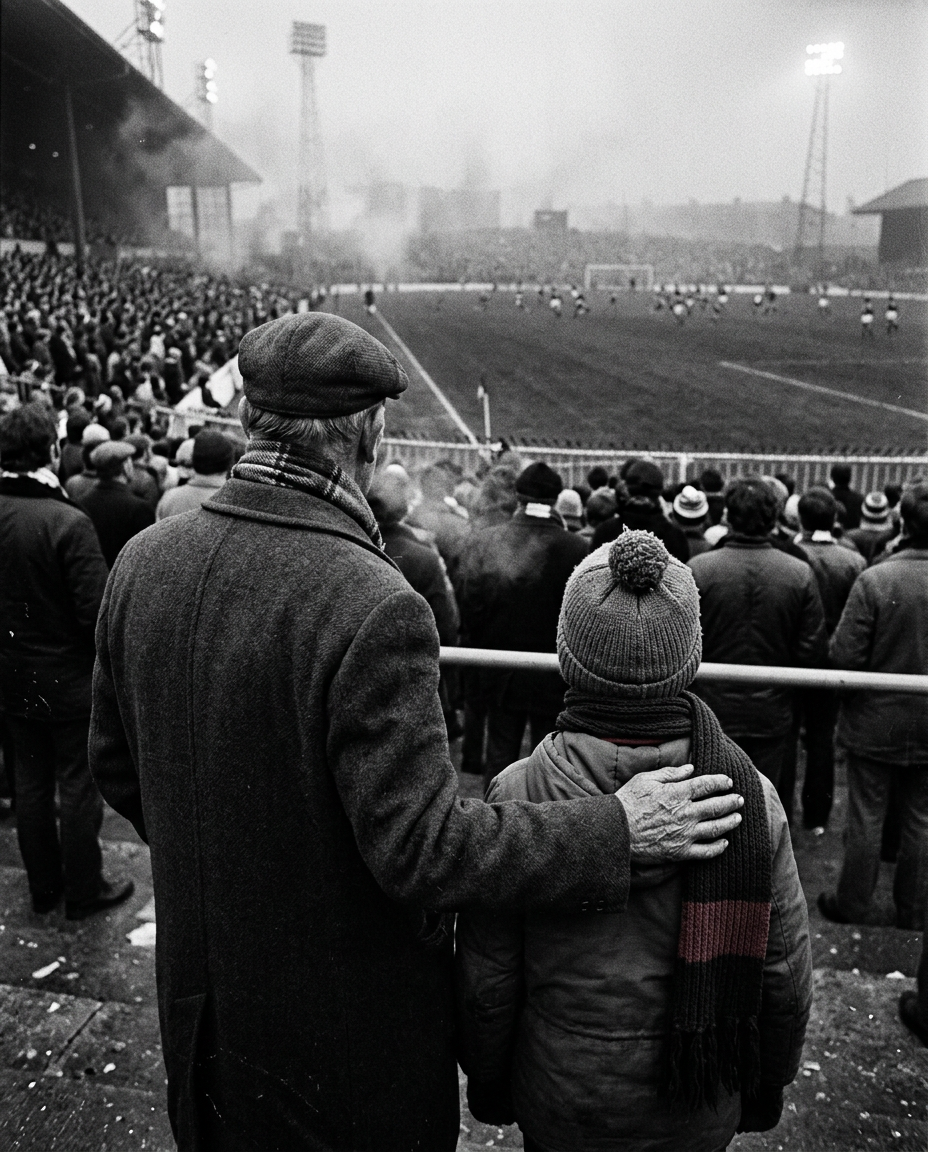
Football culture preserved many things.
Scarves.
Photographs.
Match programmes.
Ticket stubs.
Flags.
Yet some of its most important traditions left behind no physical evidence at all.
Only memory.
Only voices.
Only repetition.
Long before supporters could search for lyrics online, songs survived through a far simpler process.
People listened.
Then they remembered.
Then they sang.
That was enough.
An older supporter would begin a familiar chant.
Younger supporters joined in.
Perhaps they knew every word.
Perhaps they only knew fragments.
Over time the missing pieces were learned.
Not in classrooms.
Not from instruction manuals.
From standing together.
Every terrace possessed its own soundtrack.
Some songs celebrated victories.
Others mocked rivals.
Some carried local references that made little sense outside a particular town.
Many evolved constantly.
Words changed.
Verses disappeared.
New lines emerged.
Yet the core survived.
The crowd protected it.
What makes football songs remarkable is not their complexity.
Most are simple.
Some are repetitive.
Many borrow melodies from elsewhere.
That was never the point.
The power came from participation.
Thousands of strangers singing the same words
at the same moment.
Not because they were told to.
Because they wanted to.
There was no formal transfer of knowledge.
No official ceremony.
No certificate proving membership.
One day you arrived as a child.
The songs already existed.
Years later you realised you knew every word.
Nobody could identify exactly when the learning happened.
It simply occurred.
The culture absorbed you.
This process repeated itself across generations.
A grandfather sang a song.
His son inherited it.
His grandson inherited it too.
The lyrics survived wars, economic crises, relocations and changing football eras.
The people changed.
The song remained.
Some chants outlived the stadiums where they were first heard.
Terraces were demolished.
Entire stands disappeared.
Yet the songs travelled elsewhere.
They moved into new grounds carried only by memory.
Architecture vanished.
Voices endured.
Modern technology records almost everything.
Every goal.
Every interview.
Every match.
Football has never been documented more thoroughly.
And yet many of the most meaningful traditions continue to rely on the oldest form of preservation ever invented.
Human memory.
Perhaps that is why terrace songs feel different from other cultural artifacts.
They cannot be placed inside a display case.
They cannot be fully archived.
They only truly exist when somebody sings them.
And when thousands join in, the past briefly becomes present again.
Football supporters often inherit more than club loyalties.
They inherit rituals.
Routes.
Stories.
Beliefs.
And songs.
Especially songs.
Because songs travel where photographs cannot.

They survive inside people.
Crossing generations without paperwork, permission or planning.
Quietly passing from voice to voice.
Until nobody remembers where they began.
Only that they still belong.
And perhaps that is the highest
form of football immortality.