Football is full of famous images, but most of them are incomplete.
We remember the shot.
We remember the net moving.
We remember the scorer turning away, arms open, face lit by something larger than relief.
But that is not where the moment ends.
In football, a goal does not fully belong to the person who scores it. Not for long, anyway. Within seconds, it is claimed by others. A hand arrives first on the shoulder. Then another body crashes into the celebration. Then three more. Arms wrap around necks, shirts are pulled, heads are pressed together, and what looked like an individual act becomes what it always was: something shared.
That is the abrazo de gol.
Not the replay.
Not the statistic.
Not the caption under the highlight.
The embrace.
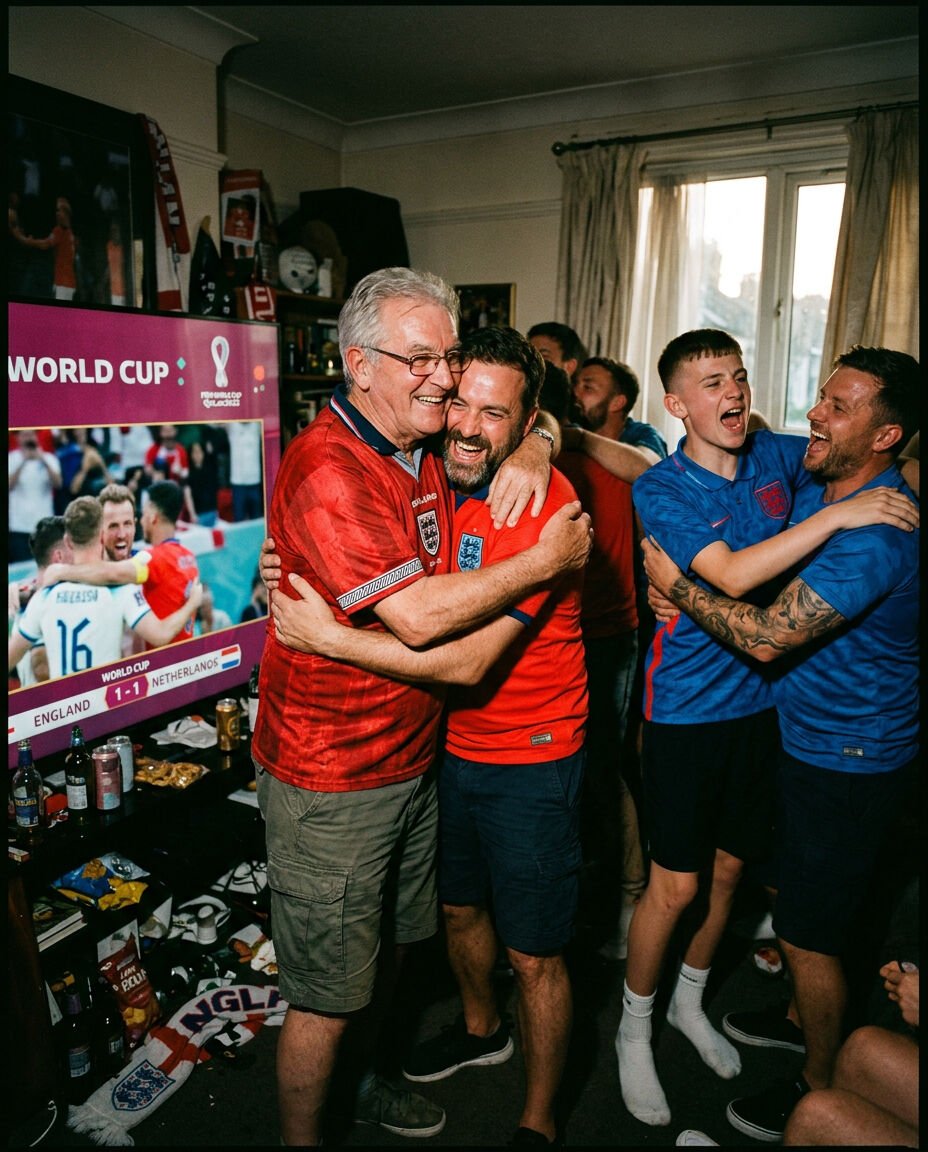
Archive 011 · Brotherhood · The Embrace
Football has always had a different relationship with joy. In many sports, celebration is personal. A fist in the air. A scream. A lap of honour. A private release made public. Football is not like that. Football is collective even in its most explosive moments. The player may score alone, but he is rarely left alone. The others come for him immediately, as if the body understands something the mind does not need to explain.
We got there together.
This belongs to all of us.
That is why the goal embrace matters more than people admit.
It tells the truth about the game.
The goal may be signed by one name, but it was built by many invisible things: a run made earlier, a tackle won in midfield, a pass made under pressure, a teammate who kept believing, a coach who insisted, a week of training, a season of frustration, years of friendship, a child's first dream, a family's sacrifice, a group's stubborn refusal to give up. All of that arrives in the embrace.
The scorer only happens to be standing at the centre of it.
And the beautiful thing is that football supporters understand this instinctively. They may argue all week about who should start, who was useless, who lost the ball too often, who should have tracked back. But when the goal comes, all that debate disappears for one brief, honest second. In the stands, people grab whoever is nearest. Friends become brothers. Strangers become witnesses. Fathers lift sons without thinking. Beer goes flying. Glasses fall off. Voices crack. In living rooms, bodies lean into each other with the same urgency seen on the pitch.
The players embrace because the supporters do too.
That is part of what makes football different from sport as content. Football is not only watched. It is lived physically. It enters the body. It closes distance. It makes people touch who would otherwise sit in silence. The goal embrace is one of the clearest examples of that. It is the game turning emotion into contact.
And it is never completely choreographed.
That matters.
The modern game has produced its share of rehearsed celebrations — point to the sky, hand over the ears, camera-ready routines, gestures built for screens. Some of them are memorable. Some of them are empty. But an abrazo de gol cannot be faked in the same way. Its force comes from interruption. It breaks the performer. It cancels the pose. It drags everyone back into the truth of the moment.
When a late winner goes in, nobody stays elegant for long.
The first teammate usually arrives with no concern for composition. He jumps onto the scorer, wraps both arms around him, shouts into his shoulder, half-falls, half-collides. Then the others arrive. The image becomes messy. Human. Genuine. If the goal mattered, the embrace shows it. If it changed something, you can see it in how tightly they hold on.

Archive 011 · Brotherhood · The Pile-On
That is why some of the most moving football images are not the shot itself, but the pile of bodies that follows.
A good embrace tells you more than a good finish.
It tells you what the group has been carrying.
Some embraces say relief.
Some say revenge.
Some say survival.
Some say disbelief.
Some say: after everything, we did it.
And perhaps the deepest ones say something even simpler: thank God I did not go through this alone.
Children understand this before they can explain it.
Long before they learn systems, before they understand offside traps or why adults insist on talking about shape and transitions, they learn football through gestures. They learn what matters from what bodies do. They see players run not only to the corner flag, but to each other. They see teammates gather around one shirt and pull it into the centre of the frame. They see joy becoming collective. And without anybody giving a lesson, they learn one.
This is not a game you carry alone.
That may be one reason the embrace remains so powerful outside the professional game. On muddy community pitches, school tournaments, Sunday morning leagues, five-a-side courts, small-town finals and training-ground friendlies, the goal embrace survives because it belongs to football at its most basic level. It does not require a camera. It does not need a trophy. It does not need fame. It only needs a group of people who wanted the same thing for long enough that, for one second, wanting turns into having.
Then comes the collision.
Then comes the laugh.
Then comes the squeeze around the shoulders.
Abrazo de gol.
The phrase itself carries more than football. In some places it leaves the stadium and enters ordinary life. It becomes a way of saying goodbye, a way of sending affection, a way of naming a type of closeness that is intense, brief, sincere and impossible to fake. That is part of its beauty. Football gives language to feelings people already had but did not know how to describe.
A hug can be polite.
A hug can be distant.
A hug can be routine.
An abrazo de gol is none of those things.
It is full commitment.
It says: I felt that too.
It says: I was there with you.
It says: after all that waiting, all that effort, all that fear, this is ours.
Maybe that is why the image stays with people long after specific matches disappear. Scores are forgotten. Tables change. Tournaments end. But the embrace remains. Not as data. As feeling. As proof that football, at its best, produces not just winners, but moments of shared arrival.
That is what Kaiser FC is interested in preserving.
Not only the trophies.
Not only the famous goals.
But the human rituals around them.
The touch after the strike.
The run from midfield.
The pile-on near the byline.
The hands grabbing shirts.
The foreheads pressed together.
The squeeze that says more than commentary ever could.
Because the goal is not complete when the ball crosses the line.
It becomes complete when someone else reaches you.
And maybe that is the deepest promise hidden inside the game: that every now and then, after pressure, doubt, work, pain and waiting, there is a moment when joy arrives — and it does not arrive alone.
It comes with others.
It comes with arms around shoulders.
It comes like football's purest language.
An abrazo de gol.