Kaiser FC/ Every Four Years/ Archive 008
Archive 008
Distance & Devotion
12 min read

The Passport
Full Of
Stamps

Some supporters do not follow football from a couch, a bar or a safe distance. They cross borders for it. They collect airports, train stations, cheap hotels, missed connections, folded flags and match tickets that cost more than they should. To outsiders, the journey may look irrational. To them, it is simple: the match was never only at the stadium. It began the moment they decided to go.

There is a moment before every football journey when the idea still sounds unreasonable. The ticket is too expensive. The flight leaves too early. The connection is too tight. The hotel is too far from the stadium and somehow still too expensive. Work has to be negotiated. Family has to be convinced. Money has to be moved from one purpose to another. A sensible person looks at the distance between home and the match and concludes that the television is enough.

But football has never belonged entirely to sensible people.

Every World Cup creates its own map, and on that map there are lines that do not appear in official tournament graphics. They are not group-stage routes or knockout brackets. They are personal routes, drawn by supporters who decided that watching from home was not enough this time. A flight from one continent to another. A night bus across a border. A train taken half asleep. A ride shared with strangers who became temporary family because they were wearing the same colours. A walk through a city that did not know their chants yet.

For some supporters, the passport becomes the quietest archive of the tournament. It does not sing. It does not wave. It does not appear in the stadium camera shot. But page by page, stamp by stamp, it records a form of devotion that football history usually ignores. The passport remembers the country entered too late at night. The border guard who asked whether the journey was really just for a match. The hotel address scribbled on a folded piece of paper. The immigration line filled with flags, scarves and nervous laughter. The moment when a supporter looked around an airport terminal and realised that half the queue was going to the same place.

A football journey has its own emotional rhythm. It begins with abstraction: fixture lists, maps, prices, dates, routes. Then it becomes physical. The bag on the floor. The shirt chosen the night before. The scarf folded with more care than any other item. The phone charger, the tickets, the passport, the printed confirmation because trust in technology has limits when the match matters. The supporter leaves home carrying objects that may look ordinary, but inside the logic of football they are ceremonial. Without them, the journey would feel incomplete.
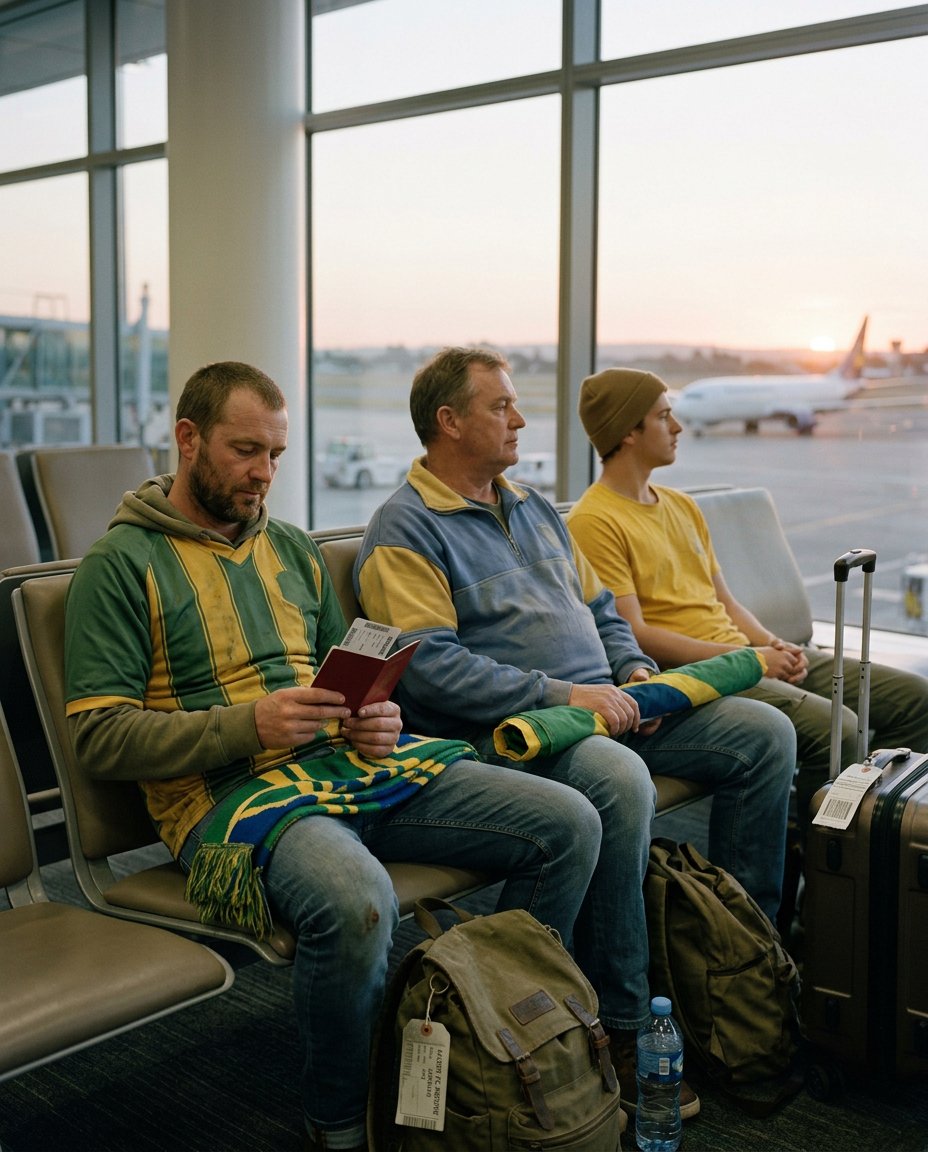
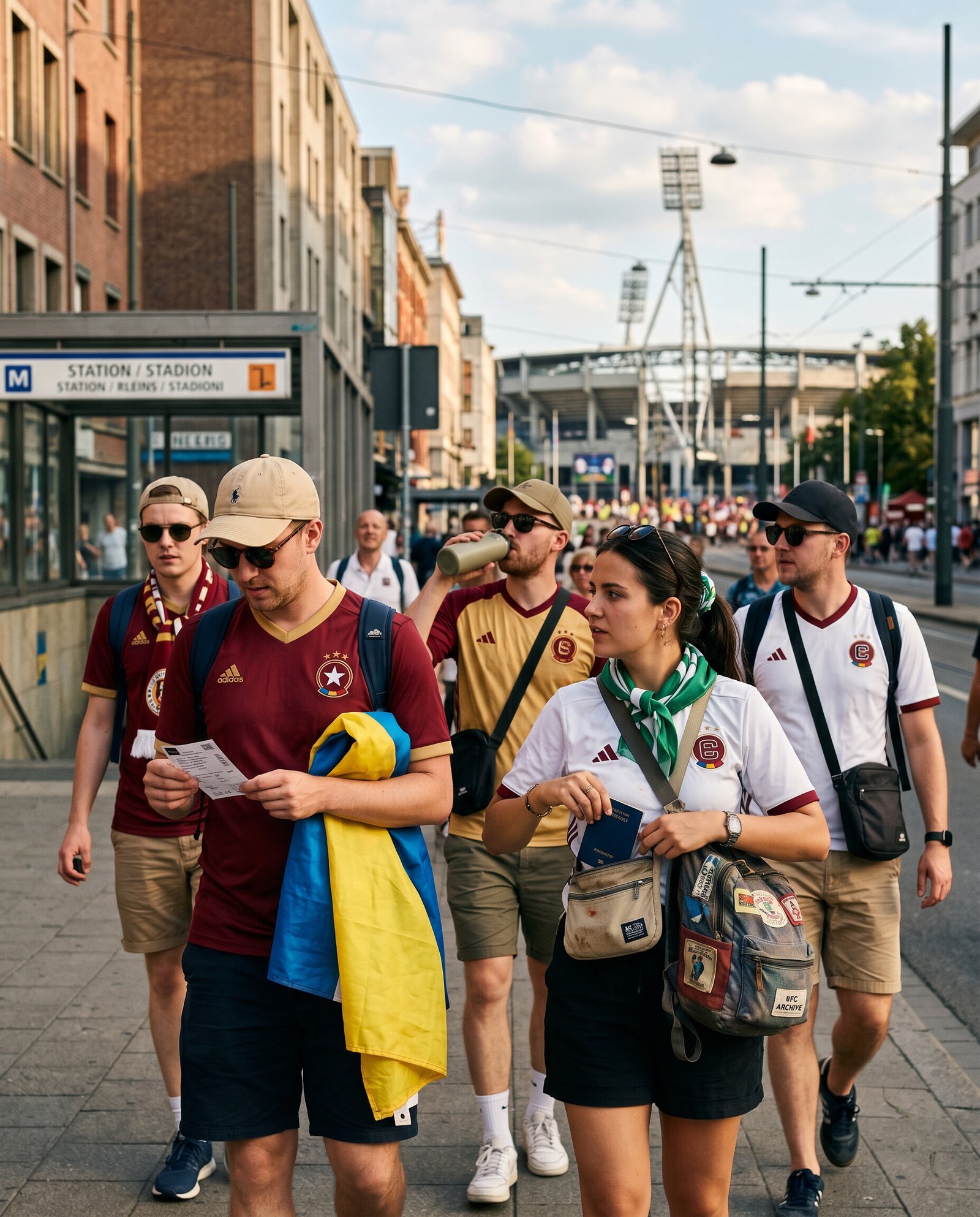
Passport, ticket, scarf and charger laid out the night before a football journey

Chosen the night before — ordinary objects, ceremonial weight

The strange thing is that most of the trip is not glamorous. It is waiting. Waiting to board. Waiting for baggage. Waiting for transport. Waiting for someone to answer a message. Waiting in a hot street because check-in is not until later. Waiting outside a stadium hours before the gates open because the body is too restless to stay anywhere else. The romance of football travel is not found in comfort. It is found in the refusal to let discomfort reduce the meaning of the journey.

At some point, every travelling supporter becomes aware of the absurdity. He may be sitting on the floor of an airport in the middle of the night, eating something wrapped in plastic, trying to sleep with one hand through the strap of his bag. He may be looking at a bank notification and pretending not to calculate the total. He may be standing in a city where he does not speak the language, wearing a shirt that tells everyone exactly why he came. In that moment, if asked to explain himself to a stranger, he might struggle. But if he met another supporter making the same journey, no explanation would be necessary.

That is one of football’s oldest forms of recognition. The travelling fan sees another travelling fan and understands the equation immediately.

The Recognition

Distance, plus sacrifice, plus colour,
equals belonging.

No speech required

The passport full of stamps is not only about distance. Some people travel thousands of kilometres and remain tourists. Others travel one border and become pilgrims. The difference is intention.

A tourist visits a place.
A supporter carries a place with him.

He arrives in another country, but part of home enters with him through the flag, the shirt, the accent, the song, the way he reacts to a name in the starting eleven. He is not merely attending an event. He is transporting memory.

That is why the first walk toward the stadium often feels more important than the match preview suggests. The supporter is no longer planning, saving, booking or imagining. He is there. The stadium is no longer a photograph on a website. It has weight, heat, smell and sound. The streets around it begin to sort people by colour. Vendors shout. Police watch. Locals record videos. Groups stop for photographs that will later become family evidence. Someone calls home on video and turns the camera toward the floodlights as if showing proof of arrival.

Then comes the moment at the gate. The ticket is scanned. The bag is checked. The body crosses a threshold. For television audiences, this moment does not exist. The broadcast begins later, when the teams line up and the camera moves with authority. But for the travelling supporter, the match has already produced one of its most emotional seconds. He has entered. All the planning, distance, cost, doubt and fatigue have been transformed into presence. The seat may be high, the view imperfect, the food overpriced, the result uncertain. None of that cancels the fact that he made it.

Inside the stadium, the passport is hidden again. It rests in a pocket, bag or hotel safe while the visible objects take over: scarf, flag, shirt, voice. But the passport remains the secret witness. It knows the match cost more than the ticket. It cost time, sleep, money, favours, arguments, missed obligations, and perhaps a promise to be more responsible next month. It knows that football does not always ask politely. Sometimes it arrives in the calendar and pulls a person across the world before reason can build a strong enough defence.

There are people who judge this kind of devotion as excess, and sometimes they are not entirely wrong. Football travel can become indulgence. It can become escape. It can become a way of avoiding more ordinary responsibilities. Not every sacrifice is noble simply because it was made for the game. Kaiser FC does not romanticise stupidity. But it would be equally dishonest to pretend that the world is built only by reasonable decisions.

Some of the most meaningful memories were made because, at least once, a person chose the unreasonable route.

The World Cup intensifies this because it is temporary. A league season returns next week. A club rivalry repeats. A local match can be rescheduled, revisited, recovered. But a World Cup match in a distant city with that team, that generation, that summer and that crowd happens once. The supporter knows this. That knowledge changes the value of distance. A trip that would otherwise seem too expensive becomes a way of refusing future regret.

Years later, the passport may expire. The shirt may no longer fit. The ticket may fade. The photographs may sit inside an old phone, half-lost between folders, or printed and placed in a box with other objects that nobody sorts properly. But certain details remain stubborn. The taxi driver who asked about the flag. The street where the chants first began. The taste of a drink bought because it was the cheapest option nearby. The stranger from another city who saved a place in line. The stadium entrance seen through heat and nervousness. The first look at the pitch. The anthem sounding different because it had travelled so far to meet him.

That is what the passport full of stamps preserves. Not only movement, but proof that football can still make people cross the world for something that cannot be guaranteed. The result may disappoint. The team may lose. The tournament may end earlier than hoped. But the journey does not disappear just because the scoreboard failed to cooperate. In some cases, the trip becomes even more important because the match itself did not provide the story everyone wanted.

The journey becomes the story.

A supporter at passport control on the journey home after a tournament
Where The Heart Insisted. Another stamp, another crossing — the journey home

There is a quiet dignity in the supporter who returns home after elimination with his bag slightly heavier and his hope slightly bruised. The airport on the way back is not the same as the airport on the way out. The shirts are no longer fresh. The flags are folded smaller. People speak less. Some watch highlights on their phones. Some avoid them. Some promise never to spend that much money again and already know they are lying. At the passport control desk, the document opens one more time. Another stamp, another crossing, another piece of evidence that the body went where the heart insisted.

Football remembers travellers poorly. It counts tickets sold, attendance figures, television audiences, tourism numbers, host cities, economic impact. It does not always remember the individual supporter who saved for two years, flew alone, stood in the wrong line, missed the shuttle, found the right gate, cried during the anthem and kept the ticket in his passport so it would not bend.

That is why the archive must remember him.

Because every four years, the tournament is not only played by teams and watched by nations. It is carried through airports, folded into bags, stamped into passports, written into excuses, paid for in instalments, and brought to life by people who decided that being there mattered.

The match lasted ninety minutes.

The journey took years.

Share This Archive
Reddit X WhatsApp
Next in Every Four Years
The Man Who Saw
Eighteen World Cups
Every Four Years — Archive 009